
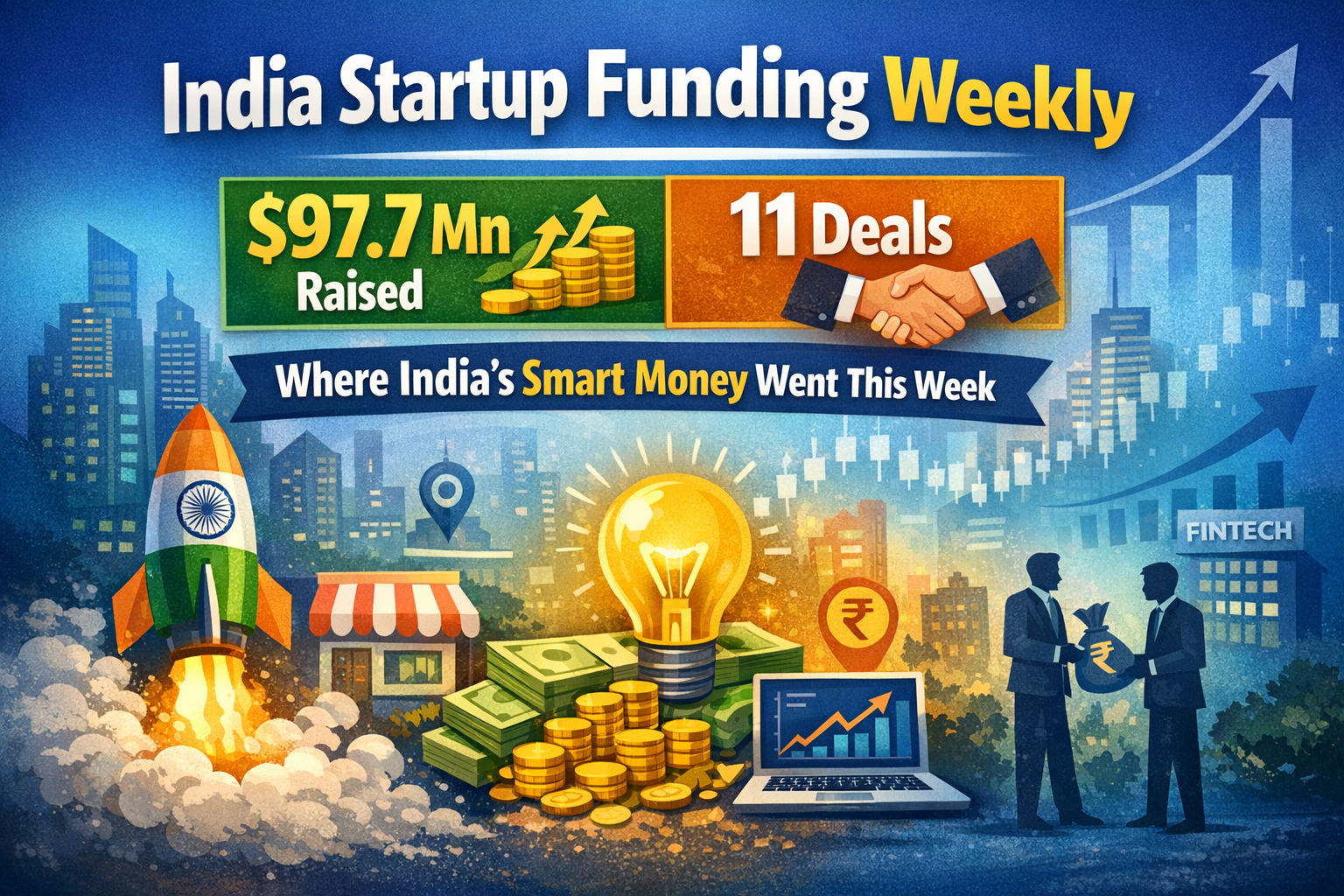
February was buzzing. Investors were writing cheques, deals were closing fast, and India’s startup ecosystem was riding serious momentum. Then March arrived – and things got quiet.
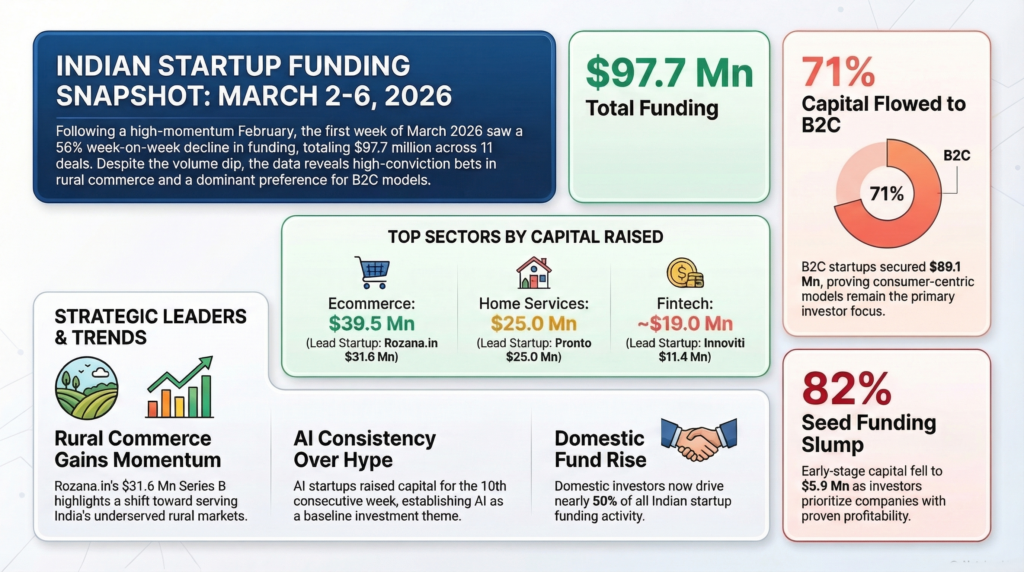
In the first week of Indian startup investment March 2026 (March 2 to 6), just $97.7 million was raised across 11 deals. That’s a sharp 56% drop from the $219.8 million raised the previous week — and barely one-third of February’s final week in terms of deal count.
So what happened? Was this a warning sign? Or just a natural pause between two busy periods? Let’s break it all down, deal by deal, sector by sector.
The Big Picture: Indian Startup Funding Weekly 2026 — Week of March 2–6
Before diving into individual deals, context matters. Indian startup funding weekly data for 2026 consistently shows that investment activity is never linear – it moves in waves. A single slow week after an elevated one is completely normal.
That said, this week’s drop was sharper than usual. Here is a clean snapshot of the key numbers:
Table of Contents
The most alarming number at first glance is seed funding — down 82% from $32.5 Mn across 15 deals the prior week. We will explain why this is likely noise and not signal in a dedicated section below.
Top Indian Startup Deals in March 2026 – Full Weekly Breakdown
Here are all the notable Indian startup deals from March 2-6, 2026, ranked by funding size.
1 Rozana.in — $31.6 Million | Series B
What Does Rozana Do?
Rozana.in is a rural omnichannel retail platform founded in 2021 by Ankur Dahiya, Adwait Vikram Singh, and Mukesh Christopher. It operates across 21,000 villages in India’s Gangetic plains and serves over 1 million active households. At the core of its model: 35,000+ women partners who act as last-mile delivery and fulfilment agents — a community-powered commerce network unlike anything else in the market.
Who Invested and Why?
The Series B was led by Bertelsmann India Investments (BII), with participation from Fireside Ventures, Spark Growth Ventures, Bikaji Family Office, and FE Securities. Rozana’s revenue has grown 4x since its last funding round — a metric that clearly gave investors confidence.
What Will the Money Be Used For?
The fresh capital will be deployed to:
- Expand from 86 stores to 200+ stores
- Enter 2–3 new states along the Gangetic belt
- Launch private-label product categories
- Broaden into fashion, electronics, and home goods
For anyone tracking India ecommerce startup investment in 2026, Rozana is the most compelling rural commerce story of the year so far. Rural India — nearly 65% of the country — is massively underserved by formal retail, and Rozana is quietly building the infrastructure to change that.
2 Pronto — $25 Million | Series B
What Does Pronto Do?
Bengaluru-based Pronto is an on-demand home services platform — plumbing, electrical, cleaning, and more – delivered within minutes of booking. The startup has scaled to nearly 18,000 daily bookings across Indian cities.
Who Invested?
The Series B was led by Epiq Capital, with Glade Brook Capital, General Catalyst, and Bain Capital Ventures participating as returning investors. Post-money valuation: approximately $100 million. The presence of General Catalyst and Bain Capital — two of the world’s most active VC firms — is a strong endorsement of Pronto’s model and the organised home services market opportunity in urban India.
3 Innoviti — $11.4 Million | Growth Round
Enterprise fintech company Innoviti provides payment infrastructure for large retail chains. The $11.4 Mn growth round was backed by Bessemer Venture Partners among others. With India’s organised retail penetration still under 10%, Innoviti is positioned in a segment with enormous runway. The company has been building toward an IPO, and this round strengthens its path there.
4 Inamo — $8 Million | Series A
Quick commerce enablement startup Inamo raised $8 Mn led by Prime Venture Partners, with Shastra VC, Antler India, and Gemba Capital co-investing. The round includes $6 Mn in equity and $2 Mn as venture debt.
Inamo helps brands participate in India’s quick commerce ecosystem — specifically platforms like Zepto, Blinkit, and Swiggy Instamart. As 10-minute delivery becomes the new normal in Indian cities, a B2B infrastructure layer is emerging around it. Inamo is building exactly that.
5 RAS Luxury Skincare — $7.5 Million | Series B
Premium D2C skincare brand RAS Luxury Skincare raised $7.5 Mn in a Series B led by Dabur Ventures, with Unilever Ventures continuing its backing. The funding will support R&D, exclusive brand stores, online expansion, and international market entry.
The strategic angle here is significant. Both Dabur and Unilever operate VC arms not just for returns — but to get early access to brands they may eventually acquire. RAS’s position as a high-quality, science-led D2C brand makes it a compelling strategic asset for either company.
6 Cent — $5 Million
Fintech startup Cent raised $5 Mn this week, continuing its work in the payments and consumer financial services space.
7 Turiyam AI — $4 Million
AI startup Turiyam AI secured $4 Mn in early-stage funding. Even in a muted week for Indian startup investment in March 2026, AI companies kept raising — a pattern that has repeated itself every single week of 2026 so far.
8 Moneyboxx Finance — $3.9 Million
MSME-focused lender Moneyboxx Finance raised $3.9 Mn, reflecting continued investor interest in fintech businesses serving India’s underbanked small business segment — a market with hundreds of millions of potential borrowers.
9 Cheerio AI — $872,000
AI-powered B2B startup Cheerio AI raised $872K in an early-stage round. A small ticket, but another data point confirming that Indian AI startups at all stages are finding funding even in slower weeks.
10 Undisclosed Startup — $273,000
A sub-$500K seed round completed the week’s deal list, rounding out 11 total transactions.
Sector Breakdown: India Ecommerce Startup Investment 2026 Leads the Week
When you look at where capital actually flowed this week, India ecommerce startup investment in 2026 dominated — and it wasn’t even close.
Ecommerce — $39.5 Mn (40% of Total)
Ecommerce led all sectors this week, pulling in $39.5 Mn across four deals. Rozana alone accounted for over $31 Mn of that figure. The sector’s dominance this week confirms a broader pattern: while urban quick commerce grabs headlines, a quieter but significant wave of capital is flowing into rural commerce infrastructure.
Home Services — $25 Mn (25.6% of Total)
Pronto’s $25 Mn Series B made home services the second-largest sector this week. India’s organised home services market is still highly fragmented, and startups that can bring trust, speed, and consistency to household services are finding strong investor backing.
Fintech — ~$19 Mn (19.5% of Total)
Fintech collectively raised around $19 Mn through four deals — Innoviti, Inamo, Moneyboxx Finance, and Cent. The range of business models here is wide: enterprise payments, quick commerce infrastructure, MSME lending, and consumer finance. Indian fintech remains one of the most consistently funded sectors in the ecosystem.
D2C Beauty — $7.5 Mn (7.7% of Total)
RAS Luxury Skincare’s raise puts premium D2C beauty on the board this week. The involvement of Dabur Ventures and Unilever Ventures signals the maturation of this category — moving from scrappy DTC brands to strategic acquisition targets.
AI and Deep Tech — ~$5 Mn (5% of Total)
Two AI startups — Turiyam AI and Cheerio AI — raised a combined ~$5 Mn. Small in absolute terms, but consistent in its message: artificial intelligence is now a baseline investment theme in the Indian startup ecosystem.
The B2C Dominance Story
Across all sectors, B2C (business-to-consumer) startups raised $69.1 Mn — capturing 71% of the week’s entire deployed capital. Six B2C companies drove this figure. Even in a slow week, consumer businesses with strong unit economics and large addressable markets attract conviction capital. India’s 1.4 billion population ensures the B2C argument remains structurally compelling.
The Seed Funding Collapse: Should You Be Worried?
Let’s address the number that looks the most alarming. Seed funding this week: $5.9 Mn across just 2 deals. The prior week: $32.5 Mn across 15 deals. That’s an 82% week-on-week collapse.
Why This Is Probably Just Noise
Indian startup funding weekly trends in 2026 consistently show that early-stage capital is the lumpiest segment of the market. Seed deals don’t close on a predictable schedule. A strong week (15 deals!) is routinely followed by a quiet one as the pipeline digests and new deals work their way through due diligence.
The Bigger Context to Watch
That said, there is a real structural trend worth monitoring. India’s full-year 2025 data showed seed funding declining about 30% from 2024 levels. Investors have pulled back from experimental, pre-revenue bets in favour of companies with clearer profitability paths. This is a global VC trend, not unique to India — but it does mean the environment for very early-stage founders is tighter than it was two years ago.
The short answer: one week’s seed data tells you very little. A full quarter’s data tells you a lot. Watch the trend, not the blip.
Who Were the Key Investors in Indian Startup Deals This Week?
No single investor dominated this week’s Indian startup deals in March 2026. Capital came from a healthy spread of domestic and international funds — which is actually a positive signal for ecosystem breadth.
Bertelsmann India Investments (BII)
BII led Rozana’s Series B — doubling down on rural commerce as a long-term conviction bet. BII has been one of the most consistent backers of India’s consumer internet and commerce ecosystem over the past decade.
Prime Venture Partners
Prime led the Inamo round and has been one of India’s more active early-stage investors in B2B and infrastructure plays. Their presence in quick commerce enablement signals an emerging thesis around the B2B layer beneath India’s delivery economy.
Bessemer Venture Partners
Bessemer backed Innoviti, continuing its long history of fintech investment in India. With a portfolio that includes Swiggy, Urban Company, and Nazara, Bessemer remains one of the most strategically active global VCs in the Indian market.
Global Blue-Chips in Pronto
General Catalyst and Bain Capital Ventures participating in Pronto’s round — even as supporting investors — underscores that global tier-1 funds continue to track India’s consumer opportunity closely, despite overall pullback in cross-border VC activity.
Indian Startup Investment in 2026: The Bigger Picture
To properly understand this week’s $97.7 Mn figure, you need the macro context of Indian startup investment heading into 2026.
India’s 2025 Funding Baseline
India raised approximately $11 billion in startup funding in 2025, maintaining its position as the world’s third-largest startup ecosystem by total capital deployed. However, deal count fell by nearly 39% — from over 2,500 rounds to around 1,518. The pattern is clear: investors are writing fewer but larger cheques, concentrating capital into companies with proven business models and realistic paths to profitability.
The Investor Pullback Is Real — But Selective
Active investors in India fell from roughly 6,800 in 2024 to approximately 3,170 in 2025 — a 53% decline. But the investors who remain active are among the most credible in the world. And crucially, domestic funds now account for nearly half of all Indian startup funding activity — up from just 28% in 2020. India’s VC ecosystem is increasingly self-sufficient.
Profitability Is the New Baseline
In 2024, 31% of Indian startups reported positive EBITDA — up from just 18% in 2021. The era of growth-at-all-costs is definitively over. Founders today are expected to demonstrate capital efficiency and a credible timeline to profitability before investors will write a cheque. The startups that raised money this week — Rozana, Pronto, RAS, Inamo — all share this characteristic: real products, real customers, and differentiated market positions.
The 2026 IPO Pipeline
After 2025’s record year for startup public listings — 18 companies listed and raised a combined ₹41,248 crore — the 2026 IPO pipeline already has 19 startups with DRHP filings submitted. India’s public markets appetite for tech companies remains strong, and successful listings create a virtuous cycle: generating returns for investors, who then redeploy into new early-stage bets.
What to Watch in the Coming Weeks: Indian Startup Deals March 2026 and Beyond
As March 2026 continues to unfold, here are the themes worth tracking closely.
1. Rural and Quick Commerce Momentum
Rozana and Inamo represent two ends of the same macro trend: India’s commerce infrastructure is being rebuilt for scale, speed, and reach. Will more investors follow into rural ecommerce and quick commerce enablement? Watch deal flow in April for confirmation.
2. AI Funding Consistency
Two AI startups raised this week. Every week of 2026 has seen at least one AI company close a round. The government’s ₹1 trillion R&D fund adds policy tailwind. Expect AI to capture a growing share of Indian startup funding throughout 2026.
3. IPO Activity in Q2 2026
With 19 startups in the DRH pipeline, Q2 2026 could be a landmark period for Indian tech public listings. Market conditions will determine how many actually list — but the pipeline is the strongest it has been since 2021.
4. Seed Stage Recovery
The 82% week-on-week seed drop is almost certainly temporary. But whether early-stage deal volumes fully recover to February levels — or whether 2026 is settling into a structurally lower early-stage base — will become clearer by mid-quarter.
5. Domestic vs Foreign Capital Balance
Domestic funds now run at approximately 50% of all Indian startup funding activity. Will Indian VCs close the gap left by retrenching global funds, or will macro uncertainty slow domestic deployment too? This balance will be one of the defining storylines of 2026.
Final Thoughts on Indian Startup Investment March 2026
A 56% drop in weekly funding sounds alarming as a headline. But Indian startup investment in March 2026 needs to be read in its proper context — not as a crisis, but as a natural correction after an elevated February.
The week’s top deals tell a coherent and optimistic story. Rural commerce is attracting serious institutional money. Quick commerce enablement is becoming its own investment thesis. Premium D2C brands backed by strategic investors are building for longevity. And AI is the quiet, consistent undercurrent beneath every week’s data.
India’s startup ecosystem is maturing. Capital is being deployed with more discipline. Founders are building for profitability as much as for scale. Domestic investors are getting stronger. And the market’s fundamentals — 1.4 billion consumers, accelerating digital infrastructure, and a deep engineering talent pool — remain fully intact.
One slow week doesn’t change any of that. The smart money is still moving. It’s just moving more carefully now.
About This Report
Written, researched, and presented by validraft.in
Data period: March 2–6, 2026