Maternity Leave Is a Constitutional Right, Not Charity: J&K High Court
Case Laws & Judgments | High Court Judgments | Published: July 13, 2026

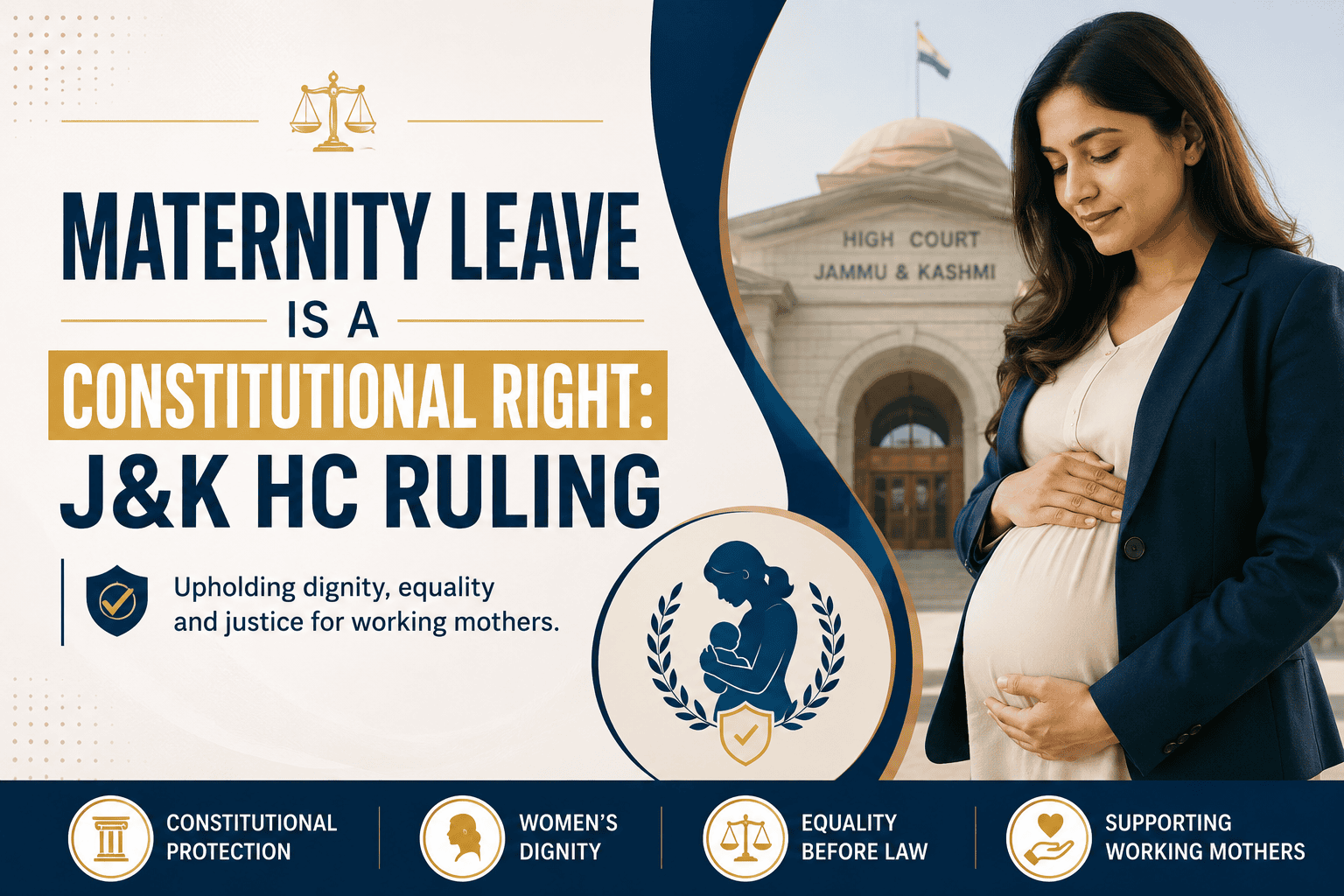
The J&K High Court has ruled that maternity leave is a constitutional right and not an act of government charity, quashing an official communication that had cut off salary payments to Senior Resident doctors and Tutors while they were on maternity leave. Justice Rajnesh Oswal, deciding the writ petition filed by Dr Sonakshi Gupta and other Senior Residents/Tutors, held on 10 July 2026 that once the Union Territory administration had already granted maternity leave under its own service rules, it could not turn around and deny pay and allowances for that same maternity leave through a later executive communication withholding salary. The judgment, reserved on 6 July 2026 and pronounced four days later, directs the Health and Medical Education Department to release full pay and allowances for the maternity leave period and for the extended residency period that followed it.
How the October 2025 Communication Cut Off Maternity Leave Pay
The petitioners were engaged as Senior Residents and Tutors under the Jammu and Kashmir Medical and Dental Education (Appointment on Academic Arrangement Basis) Rules, 2020. On 8 July 2024, the Health and Medical Education Department issued Government Order No. 451-JK(HME) of 2024, superseding earlier circulars and extending maternity leave, MTP leave, and abortion leave to postgraduate students, Senior Residents/Tutors, and DNB trainees across Government Medical Colleges in Jammu and Kashmir, in line with National Medical Commission and National Board of Examinations norms. This 2024 order also extended each trainee’s tenure by the number of maternity leave days availed, so that the prescribed residency period would still be completed in full once the leave ended.
Acting on this order, Dr Sonakshi Gupta and several other doctors went on maternity leave. Then, on 14 October 2025, the department issued a communication withholding salary and allowances for that leave, on the ground that doctors on such leave were to be treated as being out of assignment for that period. That communication withholding pay traced back to advice the Finance Department had given on 18 September 2025, after college principals had raised queries about whether Senior Residents on maternity leave should continue drawing salary. The result was that doctors who had already gone on maternity leave, trusting the 2024 order, found their pay and allowances stopped mid-leave.
The Government’s Defence, and Why the Court Rejected It
Before the J&K High Court, the Union Territory argued that the petitioners were not regular government employees but tenure-based appointees under the 2020 Rules, and so could not claim parity with permanent staff under the J&K Civil Services (Leave) Rules, 1979. It further argued that the extension of residency granted after maternity leave was purely an academic and administrative device, meant to help trainees complete their prescribed training period, and carried no independent entitlement to pay and allowances for the leave period itself. On this reading, withholding salary during maternity leave was simply the standard financial consequence of a period in which no duty had been performed.
Justice Oswal did not accept this reading. The 2024 Government Order, he noted, had granted maternity leave to Senior Residents and Tutors as per the government rules and regulations then in force, and that reference pulls in Rule 41(1) of the J&K Civil Services (Leave) Rules, 1979, as amended by SRO 353 of 2015 dated 6 October 2015. Rule 41(1) entitles a female employee, expressly including an apprentice, to up to 180 days of maternity leave with an absolute right to leave salary equal to the pay drawn immediately before proceeding on leave. Once maternity leave had been extended under the government’s own rules, the Court held, the accompanying right to full pay and allowances could not be carved out later through an internal administrative communication withholding salary. The October 2025 communication, in the Court’s assessment, was not a genuine clarification at all, but a significant departure from what the government’s own 2024 order on maternity leave had already promised.

The Constitutional Reasoning Behind the Ruling
Justice Oswal’s reasoning leaned heavily on a Division Bench ruling delivered earlier this year by the same J&K High Court, in Jammu and Kashmir Bank Ltd. and others v. Tanu Gupta (LPA No. 34/2025), a bench that included the Chief Justice and Justice Oswal himself. That judgment had held that a woman employee, even one on a contractual footing, cannot be placed at a financial disadvantage merely because she has availed maternity leave, and it traced this constitutional right back to Articles 15, 15(3), 38, 39, and 42 of the Constitution, and to the Maternity Benefit Act, 1961.
The Division Bench judgment, in turn, drew on three Supreme Court rulings that the J&K High Court applied again in the present case. In Municipal Corporation of Delhi v. Female Workers (Muster Roll), (2000) 3 SCC 224, the Supreme Court had held that women in every kind of employment must be given the facilities needed to go through motherhood with dignity, regardless of the nature of their duties or their place of work. In Deepika Singh v. PGIMER, Chandigarh, (2023) 13 SCC 681, the Court read maternity leave provisions purposively, so that women are not compelled by circumstance to give up employment after childbirth. And in Kavita Yadav v. State (NCT of Delhi), (2024) 1 SCC 421, the Supreme Court approved and applied the reasoning in Deepika Singh.
Reading these authorities together, Justice Oswal held that the government, having already built the existing service rules into its own 2024 order granting maternity leave, could not adopt an inconsistent position later by withholding salary for that same maternity leave. The judgment’s central line captures this directly: “Maternity leave cannot be reduced to a matter of state charity; it is an unassailable constitutional right anchored in the dignity of women” (para 13). Denying a mother her pay and allowances at what the judgment calls one of the more vulnerable periods of her working life, the Court reasoned, amounts to real constitutional harm, not a mere administrative inconvenience. That framing, treating paid maternity leave as a constitutional right rather than a discretionary benefit, is what gives this J&K High Court ruling its wider significance.
What the Court Ordered
Justice Oswal quashed the 14 October 2025 communication to the extent that it denied pay and allowances during maternity leave, and directed the Health and Medical Education Department to release full pay and allowances to the petitioners, both for the maternity leave period itself and for the extended residency period corresponding to the number of leave days taken. In effect, the J&K High Court closed off any administrative route to withholding salary once maternity leave has already been sanctioned under an existing rule or order. The petition, WP(C) No. 3509/2025 (O&M), was accordingly disposed of on 10 July 2026, carrying the neutral citation 2026:JKLHC-JMU:2020, and the judgment is marked as approved for reporting.
Why This Maternity Leave Ruling Matters Beyond Government Medical Colleges
The petitioners here were Union Territory government appointees, and the specific rule in dispute, Rule 41(1) of the J&K Civil Services (Leave) Rules, applies only within that service. But the reasoning behind this J&K High Court ruling travels further than the facts of this one case, and two points are worth flagging for anyone advising an employer, government or private, on pay and allowances during maternity leave.
First, the ruling treats an employee’s job classification, whether tenure-based, contractual, or fixed-term, as no defence for cutting off statutory maternity benefits once those benefits have already been extended under an applicable rule or policy. The government’s argument that the petitioners were not regular employees, and so fell outside the ordinary leave rules, failed because the government’s own 2024 order had already brought them within those rules. Employers who structure engagements as consultancies, fixed-term contracts, or academic tenures, and then rely on that structure to justify withholding salary during maternity leave, are inviting exactly this kind of challenge, particularly where the Maternity Benefit Act, 1961 already treats paid maternity leave as a statutory, near-constitutional right for their establishment.
Second, an internal administrative note, however well-intentioned on cost grounds, cannot override an entitlement that already flows from a rule, order, or policy. The Finance Department’s advice here was aimed at controlling public expenditure, a legitimate concern in the abstract, but the Court treated it as incapable of cutting down a right that the department’s own earlier order had already granted. HR and finance teams running cost-control exercises should treat pay and allowances linked to maternity leave as a category that needs a formal rule or policy change, not a quiet internal note withholding salary, if it is to be revisited at all, and even then only prospectively and within the bounds of the Maternity Benefit Act, 1961 and any applicable service rules. Getting this wrong does not just create a compliance gap; on the reasoning in this judgment, it can amount to a constitutional right being denied to precisely the employees who most need the protection at that moment, during maternity leave itself.
The Short Version
For readers short on time: the J&K High Court has held that maternity leave, once granted under an applicable rule or order, carries with it an inseparable right to full pay and allowances, and that this is a constitutional right, not a discretionary favour the state can switch off through an internal note. Withholding salary during maternity leave on the strength of a later administrative communication, where an earlier order or rule already covers that leave, will not survive judicial scrutiny. Employers reading this judgment for their own maternity leave policies should check whether their leave rules already promise full pay, since that promise, once made, is difficult to walk back.
Sources
- High Court of Jammu & Kashmir and Ladakh, official website
- Official cause list, High Court of J&K and Ladakh at Jammu — confirming WP(C) No. 3509/2025, Dr. Sonakshi Gupta and Others v. UT of J&K th. Commissioner Secretary, Health and Medical Education Department, and Others, with counsel Mr. Abhinav Jamwal for the petitioners and Mr. Raman Sharma, AAG, for the respondents
Editorial note: The full text of the judgment, Dr. Sonakshi Gupta and Ors. v. UT of J&K and Ors., WP(C) No. 3509/2025 (O&M), neutral citation 2026:JKLHC-JMU:2020, High Court of Jammu & Kashmir and Ladakh at Jammu, decided 10.07.2026, coram: Hon’ble Mr Justice Rajnesh Oswal, was verified against the certified copy of the order (marked “approved for reporting”), and cross-checked against the official cause list above for the case number, parties, and counsel of record. Readers seeking a certified copy for filing or citation purposes should obtain it directly from the High Court registry or through the e-Courts case-status service (hcservices.ecourts.gov.in) for WP(C) No. 3509/2025 at the Jammu wing.