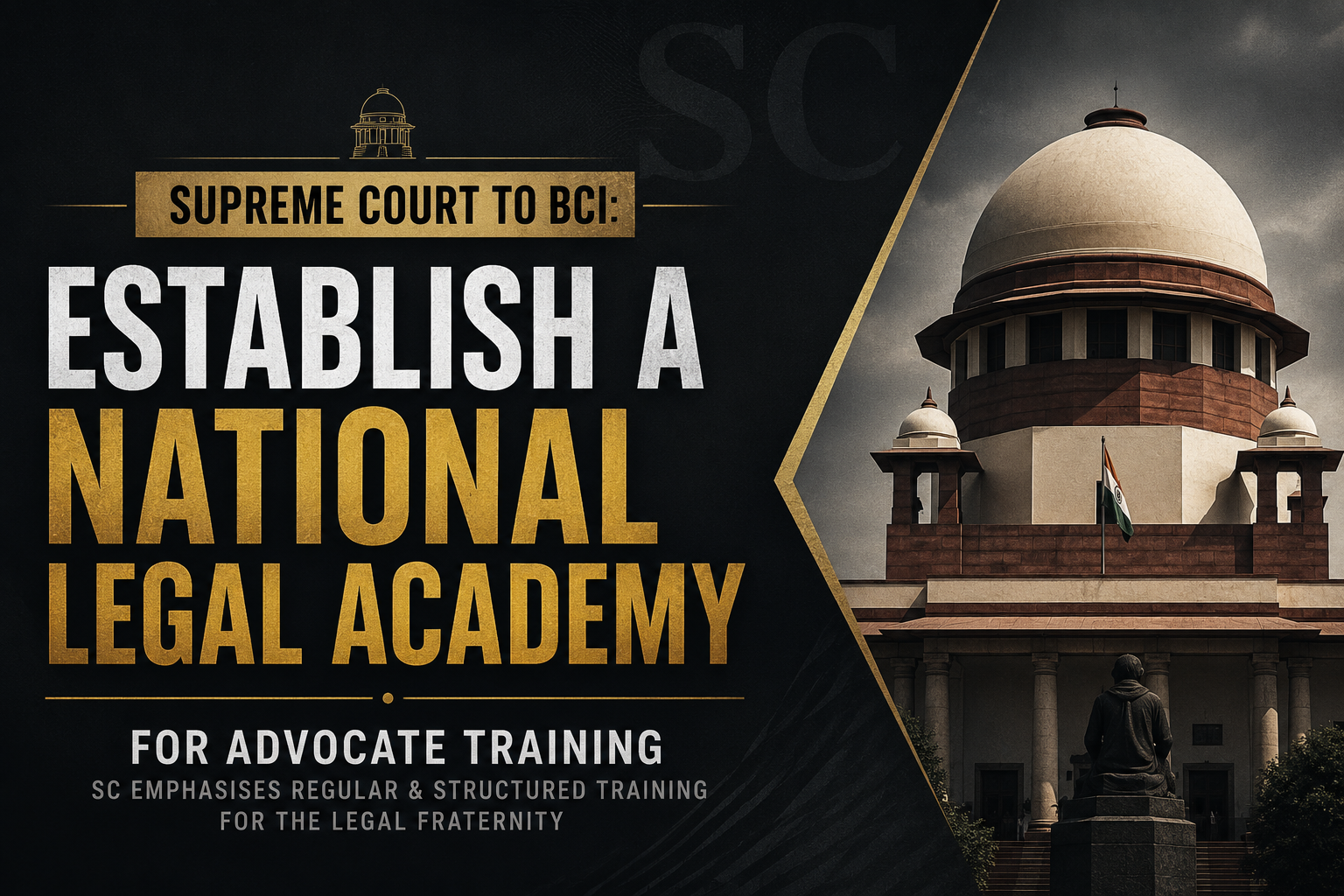
Advocates need regular, structured training long after they enrol with the Bar, the Supreme Court has held, directing the Bar Council of India to build a dedicated National Legal Academy and to institutionalise continuing legal education across the profession.

The Supreme Court of India has directed the Bar Council of India (BCI) to establish a National Legal Academy for advocates, ruling that structured, lifelong professional training is essential to maintaining competence and public trust in the justice system. Delivering judgment on July 7, 2026 in Ajay Vijh v. Indian Banks Association & Ors., a Bench of Justice Pamidighantam Sri Narasimha and Justice Alok Aradhe said the proposed academy should function on the lines of the National Judicial Academy, which currently trains judges across the country.
The Bench went further, asking the BCI to institutionalise Continuing Legal Education (CLE) for practising advocates and to conduct a performance audit of its own disciplinary machinery. The ruling has been described by the BCI itself as one of the most significant developments for India’s legal profession in recent years.
Quick Facts
- Case: Ajay Vijh v. Indian Banks Association & Ors.
- Bench: Justice Pamidighantam Sri Narasimha and Justice Alok Aradhe
- Judgment date: July 7, 2026
- Key direction: BCI to establish a National Legal Academy and institutionalise Continuing Legal Education
- Next hearing: August 31, 2026
The Case That Triggered the Order
The directions came in an appeal filed by advocate Ajay Vijh, who had been removed from Canara Bank’s panel of empanelled lawyers after the bank concluded that a legal opinion he had furnished was incorrect. Following the removal, his name was placed on the Indian Banks’ Association’s (IBA) Caution List, a register that effectively flags lawyers considered unreliable by member banks.
Vijh challenged his inclusion in the Caution List, arguing that it amounted to public blacklisting without any disciplinary finding against him. The Supreme Court agreed, setting aside his inclusion and holding that a bank’s dissatisfaction with a legal opinion cannot, by itself, justify branding a lawyer as professionally unfit in a public register.
The Court clarified that banks and financial institutions retain full contractual freedom to remove advocates from their empanelment lists at any time. What they cannot do, the Bench said, is publicly label or blacklist a lawyer over an allegation of negligence, since questions of professional misconduct fall squarely within the statutory jurisdiction of the Bar Council of India and the State Bar Councils under the Advocates Act, 1961.
Why the Court Wants Continuing Legal Education
Beyond deciding Vijh’s individual grievance, the Bench used the judgment to flag a wider structural gap: India, it observed, has almost no institutionalised system of learning for lawyers once they are enrolled with the Bar. Laws, judicial precedents, regulatory frameworks and legal technology keep changing, the Court noted, and advocates need a formal mechanism to keep pace with all three.
The Bench pointed to continuing legal education (CLE) frameworks already in place in the United States, the United Kingdom, Singapore, Canada and Australia, where ongoing training is a standard part of professional regulation rather than a one-time qualification event. It also recalled that India had considered this idea before — both the 184th Report of the Law Commission of India and the draft Advocates (Amendment) Bill, 2003 had recommended institutionalising continuing legal education — but neither recommendation was ever implemented.
The Court was clear that it does not want India to simply copy a foreign template. Instead, it directed the BCI to design a model suited to the scale and diversity of the Indian Bar, spanning senior advocates, first-generation lawyers, and practitioners in small towns and district courts alike.
Key Directions Issued to the Bar Council of India
The judgment lays out a specific set of tasks for the BCI, with defined reporting timelines. The Bar Council has been directed to:
- Initiate and institutionalise Continuing Legal Education (CLE) programmes for advocates across the country.
- Constitute a committee of senior and junior advocates, along with subject-matter experts, to examine and design the proposed Academy.
- Undertake a comprehensive performance audit of disciplinary proceedings handled by the BCI and State Bar Councils, covering pendency, delays, infrastructure, staffing and transparency.
- Identify systemic weaknesses in the profession’s self-regulatory mechanism and propose reforms.
- File a status affidavit with the Court, a week ahead of the next hearing, detailing progress on both the CLE framework and the NLA.
The matter has been listed for further hearing on August 31, 2026, when the BCI is expected to update the Court on the concrete steps it has taken.
What the National Legal Academy Is Expected to Do
While the Supreme Court has left the finer design of the National Legal Academy to the BCI-appointed committee, the broad mandate is already taking shape. Modelled on the National Judicial Academy in Bhopal, the institution is expected to serve as a national hub for continuing legal education, advanced advocacy training, ethics and professional-conduct workshops, and capacity building in legal technology.
The BCI has indicated that the academy could also play a role in mentoring, helping bridge the gap between senior and junior advocates, between lawyers in metro cities and those practising in rural and semi-urban courts, and between traditional litigation practice and emerging areas such as data protection, insolvency law, arbitration and the use of artificial intelligence in legal work.
How Other Countries Handle Continuing Legal Education
The Supreme Court’s reference to global practice is not incidental. In the United States, most state bar associations require lawyers to complete a fixed number of CLE credit hours every one to three years to retain their licence to practise. The UK’s Solicitors Regulation Authority runs an ongoing competence framework rather than a one-off exam. Singapore’s Ongoing Professional Development scheme and similar mandatory training requirements in Canada and Australia follow the same underlying logic: a law degree and Bar enrolment mark the start of a lawyer’s education, not the end of it.
India, by contrast, has historically had no post-enrolment training requirement for advocates, beyond optional workshops run by individual Bar associations or private institutions. The Supreme Court’s order pushes the BCI to close that gap through a nationally recognised, institutionalised framework.
Bar Council of India’s Response
The BCI welcomed the ruling, with Chairman Senior Advocate Manan Kumar Mishra calling it a landmark moment for the independence and institutional standing of the legal profession. In a formal statement, the Council said it would move to set up what it referred to as a National Lawyers Academy and would carry out the disciplinary performance audit directed by the Court across Bar Councils.
The Council also noted the Court’s broader observation that advocates function as officers of the court and integral participants in the administration of justice, and welcomed the clarification that questions of professional competence, negligence and misconduct fall exclusively within the BCI’s statutory domain rather than that of banks or other private institutions.
What This Means for Advocates and Law Students
For practising advocates, the judgment signals that some form of mandatory or structured continuing legal education is likely to become part of the profession in the coming years, similar to how doctors, chartered accountants and company secretaries already have continuing-education requirements in India. For younger lawyers and law students, this Academy could eventually offer standardised, affordable access to advanced training in courtroom advocacy, drafting, ethics and emerging practice areas that are currently taught unevenly across law schools and Bar associations.
For banks, insurers and other institutions that empanel lawyers, the ruling draws a clear line: they may end a professional engagement at their discretion, but they cannot use public caution lists or similar mechanisms to pass judgment on an advocate’s competence or conduct. That authority rests with the Bar Council of India and the State Bar Councils alone.
Frequently Asked Questions
What did the Supreme Court direct the BCI to do?
The Supreme Court directed the Bar Council of India to institutionalise Continuing Legal Education for advocates and to set up a committee to examine establishing a National Legal Academy, modelled on the National Judicial Academy, along with a performance audit of its disciplinary mechanisms.
Which case led to the order?
The direction was issued in Ajay Vijh v. Indian Banks Association & Ors., an appeal against the inclusion of an advocate’s name in the Indian Banks’ Association’s Caution List after his removal from Canara Bank’s panel of lawyers.
What is the National Legal Academy expected to do?
It is expected to serve as a national centre for continuing legal education, advanced advocacy training, professional ethics, and capacity building in legal technology, while helping bridge gaps between senior and junior advocates and between urban and rural practitioners.
When will the Bar Council of India report back to the Supreme Court?
The matter is listed for further hearing on August 31, 2026, when the BCI must file an affidavit detailing the progress made on Continuing Legal Education and the National Legal Academy proposal.
Can banks blacklist advocates over allegations of professional negligence?
No. The Supreme Court held that while banks may remove a lawyer from their panel at their discretion, they cannot publicly brand or blacklist an advocate through mechanisms like a caution list, since disciplinary matters fall exclusively within the jurisdiction of the Bar Council of India under the Advocates Act, 1961.
Conclusion
By linking a single advocate’s grievance to a much larger institutional gap, the Supreme Court has put continuing legal education and a dedicated National Legal Academy squarely on India’s regulatory agenda. Much now depends on how quickly and effectively the Bar Council of India translates the Court’s directions into a working framework before the matter returns before the Supreme Court on August 31, 2026. For now, the message from the Bench is unambiguous: enrolment with the Bar should mark the beginning of an advocate’s legal education, not the end of it.
For more Legal News and updates , follow Daily Business News.