Supreme Court Upholds 28% GST on Online Gaming Bets — Skill vs Chance Held Irrelevant If Money Is Staked
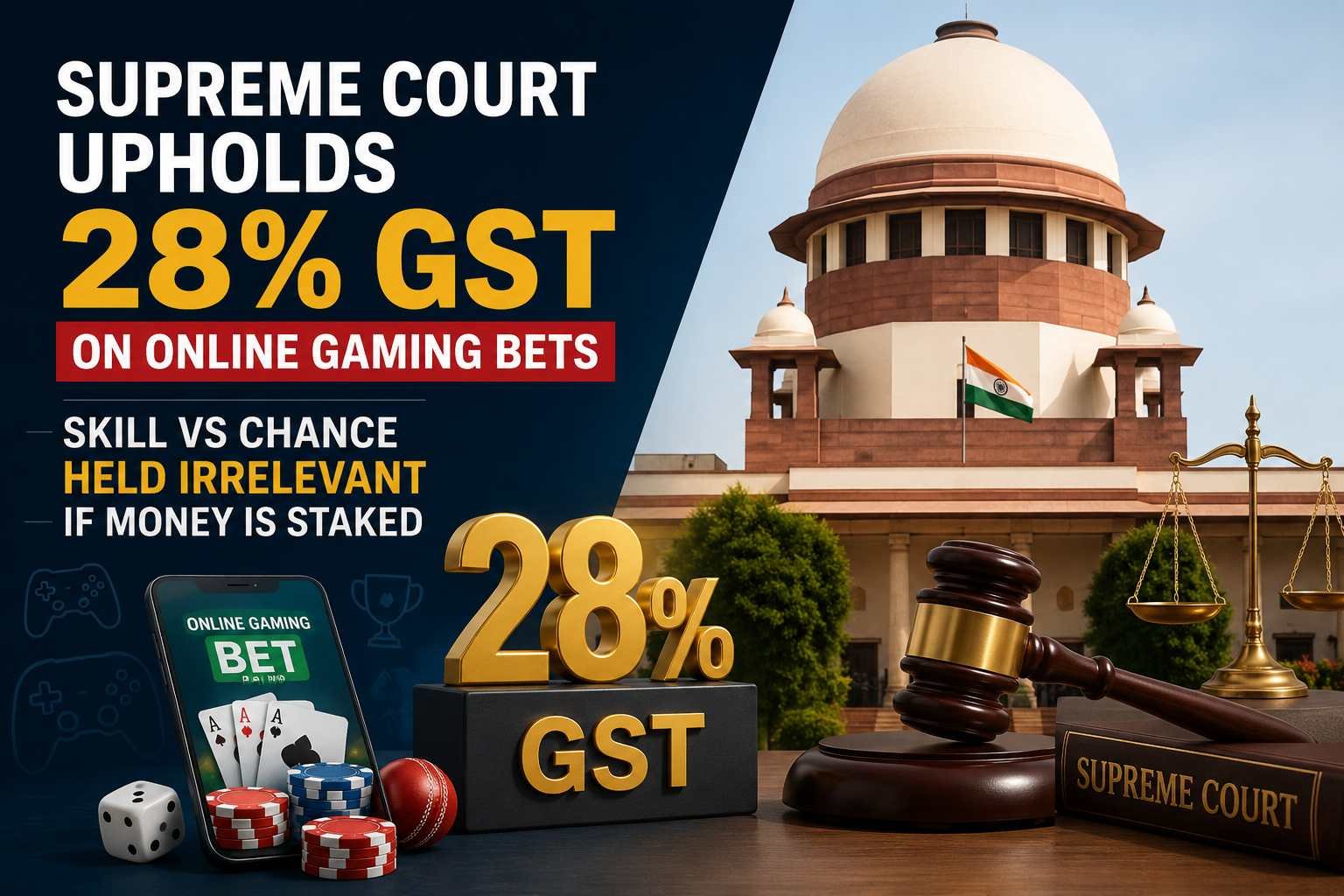
In a ruling with seismic consequences for India’s real-money gaming sector, the Supreme Court on 27 May 2026 upheld retrospective 28% GST demands on the full face value of bets — declaring that once a stake is placed on an uncertain outcome, the nature of the game is legally immaterial.
Background: How the GST Dispute Originated
The dispute traces back to the Goods and Services Tax (GST) treatment of real-money gaming platforms — companies such as Gameskraft Technologies, Dream11, Delta Corp, and Games24x7 — which had collectively generated billions of rupees in user deposits and prize pools.
The Revenue’s position, taken through the Directorate General of GST Intelligence (DGGI), was straightforward: 28% GST was payable on the full face value of each bet or contest entry amount deposited by users, not merely on the platform’s margin (commonly called the gross gaming revenue or GGR). Since the pre-2023 GST regime categorised betting and gambling as supplies of actionable claims, the department argued that the higher slab had always applied.
Gaming companies countered that GST could only be levied on the platform fee — the slice retained after distributing winnings — and that the 28% demand on total deposits was economically ruinous and legally unsustainable. They further argued that their products were predominantly games of skill, a category of constitutionally protected commercial activity under Article 19 of the Constitution, not “betting and gambling” under Entry 62 of List II of the Seventh Schedule.
The controversy sharpened after the GST Council’s July 2023 decision, which was legislatively enacted with effect from 1 October 2023, explicitly providing for 28% GST on the full face value of bets across online gaming, casinos, and horse racing. The Revenue maintained this amendment was merely clarificatory of the position that had always prevailed. Gaming firms argued it was a fresh levy that could not apply to the pre-October 2023 period.
Key Holdings of the Supreme Court
The bench of Justice JB Pardiwala and Justice R Mahadevan delivered the operative portion of the judgment on 27 May 2026. The detailed reasoned judgment is yet to be formally uploaded. The principal holdings confirmed through reliable legal reporting are:
28% GST on the full face value of bets placed through online gaming platforms and casinos is constitutionally valid and not violative of the GST constitutional scheme.
The levy is supported by statutory authority under the CGST Act and cannot be invalidated merely by separately challenging the Rules framed under the Act.
Online gaming operators are suppliers of actionable claims taxable under GST — not facilitators or intermediaries merely hosting a platform.
The skill vs chance distinction is irrelevant for GST once money is staked on an uncertain outcome. Even skill-based games acquire the character of betting and gambling in that context.
Retrospective tax demands for the period prior to 1 October 2023 are upheld as legally sustainable.
The CGST Rules empowering GST on the full value of bets through online gaming platforms and casinos are upheld.
End of the Skill vs Chance Debate for GST Purposes
The most legally consequential — and commercially devastating — aspect of the judgment is the Court’s treatment of the skill vs chance argument. For decades, gaming companies across rummy operators, fantasy sports platforms, and card game services had successfully invoked this distinction in constitutional litigation to ward off state-level prohibitions on gambling.
When the element of betting and gambling enters the picture, the nature of the game ceases to be of relevance. Article 19 of the Constitution protects a game of skill; however, once money is staked on uncertain outcomes, even skill-based games acquire the character of betting and gambling for GST purposes. The essential element of betting lies in staking money on uncertain outcomes.
— Justice JB Pardiwala & Justice R Mahadevan, SC, 27 May 2026 (as reported by Bar & Bench / Live Law)
The Court drew a critical conceptual line: the constitutional validity of running a skill-based game as a business (Article 19 protection) is a separate question from the GST character of the transaction when users put money at risk on an uncertain outcome. The former may survive; the latter is governed exclusively by the economic reality of the stake and the uncertainty of the result.
Practically, this means that whether a platform hosts rummy (predominantly skill), fantasy cricket (largely skill-and-knowledge), poker (a mixed game), or slot machines (predominantly chance) does not determine the GST treatment. If users are depositing money into a pooled fund with winnings contingent on an uncertain result, 28% GST on the gross deposit amount applies.
Operators Are Suppliers of Actionable Claims, Not Intermediaries
A central technical argument by gaming companies was that they were merely intermediaries — technology service providers facilitating a contest between users — and that any actionable claim arose between the players inter se, not between the operator and the user. On this basis, they argued that even if GST was payable, it should be on the platform fee, not the total pool.
The Supreme Court rejected this characterisation entirely. The bench held that organised online gaming — particularly fantasy games involving pooled stakes and contingent prize structures — creates actionable claims that arise from the operator’s supply. The platform is not a neutral conduit. By structuring the pool, defining the rules, accepting deposits, and distributing prizes, the operator becomes the supplier of a taxable service under the CGST Act.
This finding has a direct cascading consequence: since the operator is the supplier and the entire pooled stake constitutes the transaction value, the taxable value for computing 28% GST is the full face value of every bet or entry fee deposited — not the net revenue the operator retains.
Retrospective Demands: Pre-October 2023 Period Covered
The most financially damaging aspect of the ruling for gaming companies is its retrospective reach. The industry had argued that even if the post-October 2023 regime was unassailable, the prior period could not be taxed at 28% on the full deposit value since no specific provision existed at that time.
The Supreme Court disagreed. It accepted the Revenue’s position that the 2023 GST Council amendment was declaratory in nature, clarifying what the law had always been rather than introducing a new levy. Accordingly, the 28% GST on the full face value of bets applies to transactions predating 1 October 2023 as well.
Karnataka High Court Ruling Set Aside — Gameskraft SCN Restored
The anchor case before the Supreme Court was the DGGI’s challenge to a Karnataka High Court judgment that had quashed a September 2022 show-cause notice issued to Gameskraft Technologies Pvt Ltd demanding approximately ₹21,000 crore in GST.
The High Court had held that rummy — the core product on Gameskraft’s platform — was a predominantly skill-based game, that Gameskraft was not supplying actionable claims in the manner alleged, and that the show-cause notice was therefore without jurisdiction.
The Supreme Court has set aside that High Court judgment in its entirety and has restored the September 2022 show-cause notice. However, it has clarified that the final adjudication on Gameskraft’s liability will be conducted by the concerned GST authority in line with the principles laid down in the Supreme Court’s ruling. In short, the notice is live; the quantum of liability is to be determined by the adjudicating authority.
Financial Impact: What the Numbers Say
The financial stakes in this litigation are extraordinary. Based on state filings placed before the Court during proceedings, the following demand figures have been reported:
| Category | Reported GST Demand | Basis |
|---|---|---|
| Digital / Online Gaming Entities | ~₹91,685 crore | State filings submitted during SC proceedings |
| Including Casino Operators | ~₹1,08,500 crore | State filings submitted during SC proceedings |
| Gameskraft Technologies (single entity) | ~₹21,000 crore | September 2022 show-cause notice (now restored) |
| Total Industry Exposure (reported) | ~₹2.5 lakh crore | Broader industry estimate including contingent demands |
These are demand figures — the final admitted tax liability in each case will be determined through adjudication proceedings before the relevant GST authorities. Nonetheless, the combined exposure is among the largest in Indian tax litigation history.
The ruling also confirmed the judicial enforcement of backdated tax liabilities, which introduces severe pressure on the cash flows and net worth of domestic real-money gaming startups — many of which were already commercially stressed by regulatory changes described below.
Timeline of the Key Events
2022
HC
2023
2023
2023
2025
2026
2026
Industry Aftermath
The Supreme Court’s ruling lands on a sector already fundamentally reshaped by regulation. Parliament passed the Promotion and Regulation of Online Gaming Act in August 2025, which banned online money gaming in India and came into force in May 2026 — the same month as this judgment. Platforms that had once been valued in the billions of dollars — including Dream11, Gameskraft Technologies, and Games24x7 — were already pivoting away from real-money formats or winding down those businesses entirely.
The SC ruling therefore serves a dual function in the industry context: it validates massive retrospective tax demands on businesses that no longer exist in their original form, and it forecloses any future real-money gaming operator from structuring its tax position around the GGR argument.
Petitioners and Industry Bodies Covered by the Ruling
The Supreme Court’s ruling in the Gameskraft case was heard alongside related petitions filed by several major stakeholders, including:
- Delta Corp — a listed casino and online gaming company
- All India Gaming Federation (AIGF) — the principal industry body
- E-Gaming Federation (EGF)
- Federation of Indian Fantasy Sports (FIFS)
- Multiple other online gaming and fantasy sports platforms whose petitions were transferred from various High Courts to the Supreme Court
Pending show-cause notices, adjudication proceedings, and tax demands against all online gaming, fantasy sports, and casino operators will now be decided by the respective GST adjudicating authorities in accordance with the principles laid down by the Supreme Court.
Frequently Asked Questions
What exactly did the Supreme Court decide on 28% GST on online gaming?
Does the skill vs chance distinction still matter legally after this judgment?
Is the 28% GST on the total deposit or only the platform fee?
What happened to the Karnataka High Court ruling that favoured Gameskraft?
What is the total GST demand on the online gaming and casino industry?
What is the current legal status of online gaming in India?
Conclusion
The Supreme Court’s 27 May 2026 ruling in DGGI v. Gameskraft Technologies Pvt Ltd is one of the most consequential GST judgments in India’s tax jurisprudence. It decisively closes two lines of defence that the online gaming industry had maintained for years: the skill-based game exception and the GGR valuation argument.
Three propositions now stand settled as a matter of law:
- The taxable character of an online gaming transaction for GST is determined by the act of staking money on an uncertain outcome — not by the quantum of skill involved in the game.
- Online gaming platforms are suppliers of actionable claims under the CGST Act; GST is levied on the full face value of bets, not on the platform’s net margin.
- The retrospective application of 28% GST to the pre-October 2023 period is constitutionally and statutorily valid.
Given that the Promotion and Regulation of Online Gaming Act has already taken effect and most real-money platforms have ceased operations, the practical impact of this ruling will be felt primarily in the enforcement of historic tax arrears — a process that GST adjudicating authorities will now commence in earnest, guided by the Supreme Court’s framework.
The detailed reasoned judgment, when published, will be essential reading for tax practitioners, gaming lawyers, and policy researchers. It is expected to elaborate on the constitutional analysis of actionable claims, the limits of Article 19 protection in betting contexts, and the basis for treating the 2023 amendment as clarificatory rather than prospective.