India Wealthtech Funding 2026: There has been a change in the trend of investing in Indian wealthtech this year. In the past, it was a no-brainer for traders to use trading apps or broking platforms. Not anymore. As capital shifts, it’s now looking for digital wealth management, alternative investments, fixed income products, and advisory tools designed head-to-head for a group of investors that’s just getting started: First-time investors. This makes India Wealthtech Funding 2026 a noteworthy tale to follow today.
According to data from Entrackr, $317 million has been raised through 26 deals so far in the first eight months of 2026. If you think that’s a lot, you’re not wrong because that’s half of what you’ve got in 2024, and you have 4 months still to go. In any case, India Wealthtech Funding 2026 is definitely having an exceptional year.
India Wealthtech Funding 2026: It’s booming rapidly, but big rounds are still scarce
Beware of the headline number, and a more interesting picture emerges. Much of what has happened in 2026 has been in smaller, pre-breakthrough rounds, rather than the big headline deals. The Veriqus Group, Neo and Sahi, as well as Centricity at Gurugram, have seen only four transactions this year crossing $30 million. None of them has made it over $50 million.
This may soon be changing. Reportedly, Dale Vaz’s Sahi is in talks to clock in a much higher figure, around $80 million, and it is believed that Accel, Growth and Bessemer are in the fray.
At this time, however, the trend implies some investor thinking in this field. They’re giving out smaller payouts to a wide selection of startups; they’re also turning down bigger offers for those on the proven side.
Here’s how funding has trended over the past four years:
| Year | Capital Raised | Number of Deals |
|---|---|---|
| 2023 | $55 million | 12 |
| 2024 | $265 million | 26 |
| 2025 | $369.34 million | 25 |
| 2026 (Jan–Aug) | $303 million | 25 |
The funding increased over 3X in 2024 compared with 2023. It then jumped again in 2025, increasing by about 40 percent, despite the slight increase in deal count. With eight months of data under its belt, 2026 has already surpassed all of 2024, which is an indicator that investors who may have had some reservations about this sector are losing that fear. Here is why India Wealthtech Funding 2026 is being closely eyed in the startup ecosystem this year-on-year.
However, not all of the wagers have been successful. Less than a year after its launch, Dream Sports, the owner of Dream11, shut down its Dream Money wealth management initiative. It was one of the company’s forays into non-gaming, and it failed to take hold.
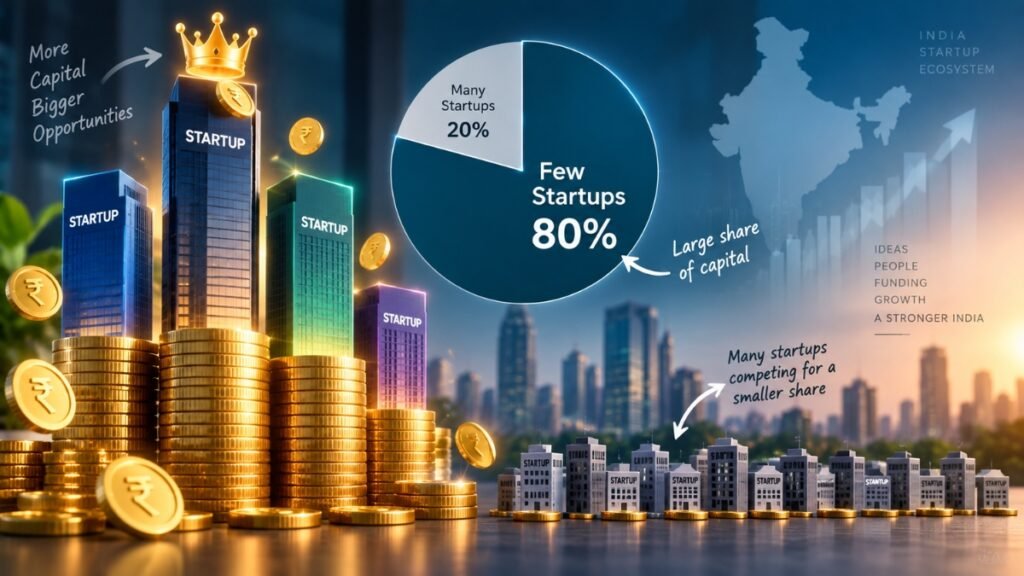
A small number of startups are capturing a large share of the capital
Money collected in 2026 does not go toward the low-income population equally, by any means. It’s been attracted by a small group of companies.
Mumbai’s Veriqus Group topped the list with $40 million led by Norwest Venture Partners. Neo Group wasn’t far behind, at $36.3 million, with backing again by Peak XV Partners, who had already backed the company. Sahi has raised a Series B round led by Accel and Elevation Capital, and Centricity a Series A round led by SMBC Asia Rising Fund, with $30 million raised. Stable Money, the investment firm founded by Bengaluru’s entrepreneurs, has raised an impressive sum of close to $39.3 million in two rounds, supported by Fundamentum, Peak XV Partners, RTP Global, and Z47.
These five companies make up for over half of the total amount raised under the India Wealthtech Funding 2026 banner to date.
This doesn’t mean that nobody else is receiving funding. Wint Wealth rounded up a $28 million Series B, while smaller rounds were received by Nexedge Capital, AssetPlus, Oolka and Bachatt. The interest is widespread; it’s simply that the large checks are coming in on a short list of names.
The sector is subtly transforming due to consolidation
Funding rounds don’t tell the whole story. Dealmaking is also starting to gain traction, though at a much smaller pace, with only four M&A transactions in wealthtech so far this year, three of which are of one company: Raise Financial Services, the parent of Dhan. The fundraises are no longer the only thread in the India Wealthtech Funding 2026 story; there is a new one on consolidation as well.
Raise acquired private market platform Infinyte Club and algo-trading platform Stratzy back in April. A month later, IRDAI-registered GreenLife Insurance Broking joined the party, providing the company with its first real insurance distribution platform. All these moves are more of a strategy than an opportunistic bolt-on and more of a plan to create something bigger than a broking app.
One more came from a different quarter. With Bluechip’s clients and staff transitioning into Scripbox, the deal provided a quick shot in the arm for the mutual fund distributorship business of the latter, which has not recorded much growth in its distribution business.
What this means for the road ahead
Raising capital is clearly an area that is attracting a lot of capital into wealthtech in India, but it was always the easier half of the task. The larger challenge is to convert the funding raised by the India Wealthtech Funding 2026 into sustainable businesses if the trends continue. The next step from turning that funding into businesses that actually last is the tougher test. Investors seem to be picky about where they invest, and the few big players are taking the lion’s share of the money, even as dozens of smaller companies test new wealth management, alternative and advisory models.
The most apparent area where we still have some gaps to be plugged is geography. Wealthtech in India is still a Tier 1 city phenomenon with respect to the location of start-ups and the users of the start-ups. There’s still time for those who are willing to build for smaller cities and towns. When combined with the continued growth among new investors seeking to get into the market, it’s not surprising that the next few years are going to be dramatically different from the past few years.