Dangote Refinery Lists on Nigerian Exchange on 1 December After IPO That Values It at About $47 Billion
Dangote Petroleum Refinery is due to list on the Nigerian Exchange on 1 December 2026. Applicants for up to 10 million shares get full allotment, and the offer price implies a value of about 65.87 trillion naira, roughly $47 billion.
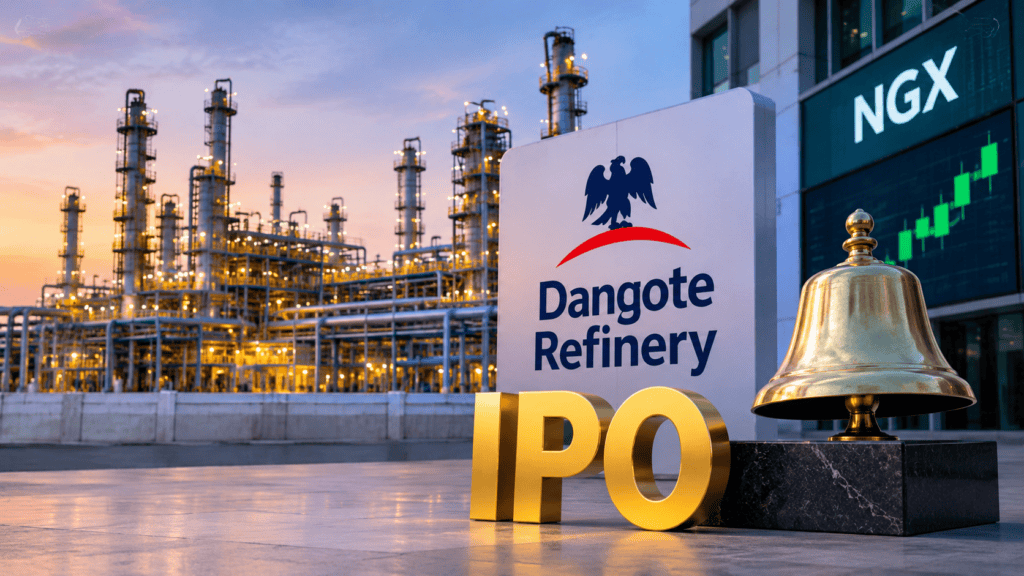
Shares in Dangote Petroleum Refinery and Petrochemicals FZE are due to start trading in Lagos on Tuesday, 1 December 2026, when 125,458,915,901 of them join the Nigerian Exchange (NGX) Main Board. The listing completes the Dangote refinery IPO that founder Aliko Dangote pitched to ordinary Nigerians and Africans. At the offer price of 525 naira a share, that share count gives the company a market value of about 65.87 trillion naira, roughly $47 billion.
Ahead of the debut, the Johannesburg Stock Exchange (JSE) said on 27 November it is working with the Dangote Group on a possible secondary listing in South Africa.
The Dangote refinery IPO in one table
The listing notice, the allotment plan approved by Nigeria’s Securities and Exchange Commission (SEC), and the company’s own statements set out the main terms.
| Item | Detail |
|---|---|
| Issuer | Dangote Petroleum Refinery and Petrochemicals FZE, Lekki, Lagos |
| Offer price | 525 naira per share |
| Minimum application | 10 shares (5,250 naira) |
| Original offer | 4.1 billion shares, about 2.15 trillion naira, with a 30% upsize option |
| Shares allotted | 5.196 billion, about 2.73 trillion naira (around $2 billion) |
| Offer closed | 27 October 2026 |
| SEC approval of allotment | 23 November 2026 |
| Shares to be listed | 125,458,915,901 ordinary shares |
| Listing date and venue | 1 December 2026, NGX Main Board |
| Founder’s stake | About 87.3% before the offer, about 84% after |
Demand for the Dangote refinery IPO was broad. The company said investors from 120 countries, including all 54 African countries, applied for shares. Investor reach came partly through NGX Invest, a digital platform that, according to the exchange group, linked 186 distribution channels including stockbrokers, banks, fintech apps and WhatsApp.
How the Dangote refinery IPO shares were allotted
Under the allotment schedule approved by the SEC, small investors were protected. About 3.2 million applicants asked for 100 shares or fewer, and every applicant seeking up to 10 million shares is due to receive the full amount requested.
In the Dangote refinery IPO only the largest bids were scaled back: 41 investors who asked for more than 10 million shares each. Under the schedule, shares go into investors’ accounts at Nigeria’s central depository within 15 working days. Money owed back to applicants who got fewer shares than they asked for, or none, should be returned within five working days of the allotment being announced.
“With a minimum subscription of just 10 shares, the offer is designed to give ordinary Nigerians and Africans an opportunity to own a stake in the refinery.”
Aliko Dangote, at the IPO launch, September 2026

Valuation, worked out from the official figures
Reports on the Dangote refinery IPO give slightly different valuations, because they use different share counts and exchange rates. Using the figures in the listing notice:
- Market value at the offer price: 125,458,915,901 shares × 525 naira = about 65.87 trillion naira, the amount the listing is expected to add to NGX’s market capitalisation.
- In dollars: Reuters calculated an IPO-implied value of about $47 billion from the offer price and the registered share count.
- Share of the company sold: the 5.196 billion allotted shares are about 4.1% of the shares to be listed, a calculation based on the two official counts.
Either way, the Dangote refinery IPO values the business at more than twice the roughly $20 billion it cost to build, on the company’s own construction figure.
What the money is for
According to the company’s prospectus, part of the net proceeds of the Dangote refinery IPO will help pay for an expansion programme estimated at $14.3 billion. It aims to roughly double refining capacity from about 700,000 barrels a day to about 1.4 million, a target the company has set for 2029.
The refinery, built for around $20 billion, started operating in 2024. Its crude distillation capacity is put at 650,000 to 700,000 barrels a day, which puts it among the largest refineries in the world.
The refinery’s recent numbers
Exports have climbed this year. Data from the commodity analytics firm Vortexa show the refinery’s seaborne refined-product loadings averaged around 400,000 barrels a day between January and October, about 50% more than in the same months of 2025.
| Period | Refined-product loadings | Source |
|---|---|---|
| January–October 2026 (average) | About 400,000 barrels a day | Vortexa |
| October 2026 | 550,000 barrels a day (then a record) | Vortexa |
| First three weeks of November 2026 | 575,000 barrels a day (new record) | Vortexa |
Mick Strautmann, a market analyst at Vortexa, said the refinery has been “one of the few places that’s adding a lot of fuel supply to the Atlantic Basin”, while making West Africa less dependent on fuel imports, particularly gasoline from Europe. The refinery has also become a key supplier of jet fuel as buyers turned to West Africa during Middle Eastern supply disruptions linked to the Iran war.
What the listing means for small investors and markets
The Dangote refinery IPO changes the make-up of Nigeria’s stock market and the position of millions of first-time shareholders. From the documents and named sources:
| Group | What changes |
|---|---|
| Retail applicants (up to 10 million shares) | Full allotment; shares credited within 15 business days of allotment |
| Large applicants (above 10 million shares) | 41 bids scaled back; refunds of the excess due within five business days |
| Nigerian Exchange | About 65.87 trillion naira added to market capitalisation at the offer price |
| Aliko Dangote | Stake falls from about 87.3% to about 84%; he keeps control |
| Johannesburg Stock Exchange | Seeking a secondary listing, which would give South African investors access |
Temi Popoola, chief executive of NGX Group, said the listing “will mark an important milestone for Nigeria’s capital market”, showing it can support large industrial companies and raise long-term capital.

Johannesburg courts a second listing
JSE chief executive Valdene Reddy said in an interview with Bloomberg Television that the exchange worked “very closely” with the Dangote Group and the Nigerian exchange before the IPO, and that a secondary listing in Johannesburg would be the ideal next step. No decision on such a listing has been announced. Any secondary listing would come after the Dangote refinery IPO debut in Lagos.
Questions analysts are raising
Not all commentary is upbeat. Cyril Widdershoven, an energy analyst at Blue Water Strategy, pointed to construction costs, commissioning delays and the risk that new capacity arrives when refining margins are weaker. David Omojomolo, Africa economist at Capital Economics, said the IPO has drawn global attention because the refinery is seen as a rare industrial-policy success on the continent.
These are the views of the named analysts. DBN makes no forecast of how shares from the Dangote refinery IPO will trade.
What to watch from 1 December
- The first day of trading on the NGX Main Board, and whether the 1 December date holds; one company source said it moved from 30 November.
- Crediting of Dangote refinery IPO shares and payment of refunds within the stated windows.
- Any formal decision on a Johannesburg secondary listing.
- Progress on the $14.3 billion expansion towards 1.4 million barrels a day by 2029.
Sources
- Listing notice details: Dangote Refinery set to list on NGX on 1 December (The Guardian Nigeria)
- SEC-approved allotment schedule (Leadership)
- CNBC, 28 November 2026: Vortexa data, analyst views, Reuters valuation
- Bloomberg, 27 November 2026: JSE chief executive on a secondary listing
More from the region: Middle East & Africa and World Business News.
Disclaimer: The content published by Daily Business News is based on information compiled from publicly available sources. While reasonable efforts are made to ensure accuracy and reliability, Daily Business News does not warrant the accuracy, completeness, authenticity or timeliness of such information and shall not, to the extent permitted by applicable law, be liable for any errors, omissions, inaccuracies, misrepresentations or losses arising from reliance on the published content.
The content is intended solely for general informational purposes and does not constitute legal, tax, financial, investment, accounting or any other professional advice. Readers are advised to independently verify the information and seek appropriate professional advice before making any decisions.
This story follows our editorial policy. Spotted an error? Tell us.