Saudi Arabia Reins In Vision 2030 Spending as Economy Shrinks and 2027 Budget Trims Outlays
Saudi Arabia's economy minister says Vision 2030 has moved from spending 'at any cost' to 'at the right cost'. The 2027 budget trims spending to about 1.39 trillion riyals as GDP contracts and Houthi strikes weigh on the plan.
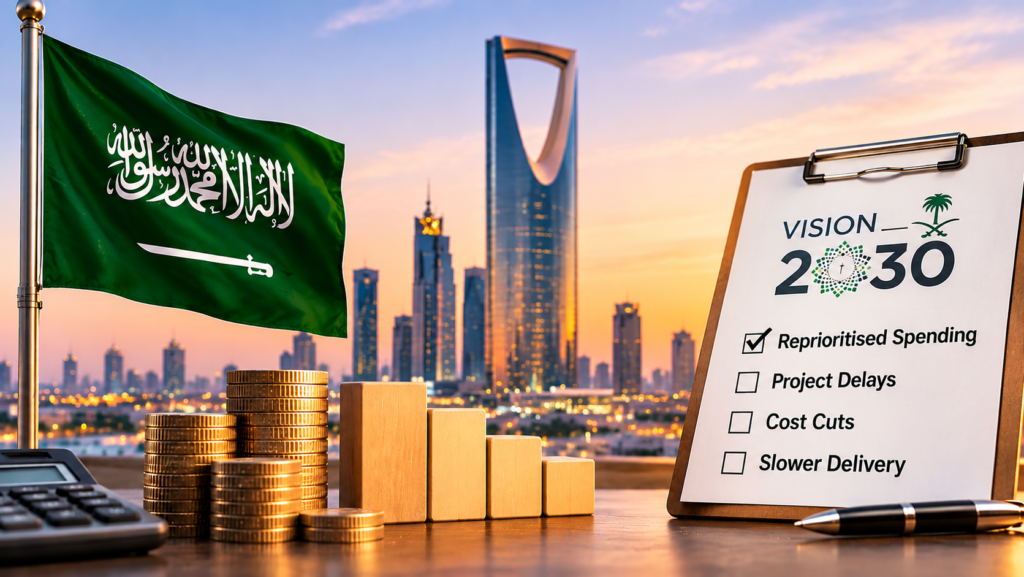
For most of the past decade, Saudi Arabia’s Vision 2030 spending followed one rule: build fast, whatever the bill. On Friday, 27 November 2026, Economy Minister Faisal Alibrahim said that rule has changed, describing a move from “spending and delivery at any cost” to “spending and delivery at the right cost” as the kingdom deals with a sharp economic contraction and Houthi strikes on its infrastructure.
His comments, in an interview with CNBC, follow a 2027 budget that cuts total spending to about 1.39 trillion riyals and keeps a deficit of about 190 billion riyals. Together they show how Vision 2030 spending is being reordered, with some giga-projects slowed and money moving to services, defence and debt costs.
Old approach vs new: what the minister described
Alibrahim set out the change in plain terms. The early phase of Vision 2030, launched in 2016 to reduce the kingdom’s reliance on oil, relied on government money to catch up. The current phase, he said, is about precision and returns.
| Aspect | Earlier Vision 2030 phase | Current phase, per the minister |
|---|---|---|
| Guiding principle | “Spending and delivery at any cost” | “Spending and delivery at the right cost” |
| Who leads investment | Government spending, much of it through the Public Investment Fund (PIF) | Less dependence on government spend; more room for private and foreign capital |
| Policy method | Project-led | “A policy-first approach” |
| Business rules | — | Bringing Saudi regulation in line with international law, including a minimum effective tax of 15% on the profits of multinationals |
“The phase we’re in today is one where every riyal is deployed with greater precision.”
Faisal Alibrahim, Saudi Economy Minister, 27 November 2026
Alibrahim said the new minimum tax would “create a clearer environment for the private sector to operate”, as the government tries to draw in more foreign investment. In practice, the new approach to Vision 2030 spending asks private and foreign investors to carry more of the load that the state and PIF once carried alone.
The numbers behind the shift in Vision 2030 spending
The Ministry of Finance’s 2027 budget statement, approved in late November, puts figures on the change. The table compares the ministry’s estimate for 2026 with its plan for 2027.
| Item | 2026 (estimate) | 2027 (budget) |
|---|---|---|
| Total revenue | 1.191 trillion riyals | About 1.2 trillion riyals |
| Total spending | About 1.43 trillion riyals | About 1.39 trillion riyals |
| Deficit | 4.9% of GDP | About 190 billion riyals, 3.6% of GDP |
| Real GDP growth | −2.1% | +10.9% (ministry projection) |
| Military spending | — | 263 billion riyals, the largest single sector |
| Municipal services | 83 billion riyals | 93 billion riyals |
Finance Minister Mohammed al-Jadaan said the 2026 contraction came from lower oil output. The ministry estimates 2026 revenue 7.1% higher than in 2025 and 3.7% ahead of the original budget. The overall message for Vision 2030 spending is a smaller total with a different mix.
MEED, which reviewed the full budget statement, reported more detail. Capital spending is set at 178 billion riyals for 2027. Subsidies fall 61.6% to 18 billion riyals after a review of payments to electricity and water companies, and financing costs rise 31.1% to 93 billion riyals.
Public debt is projected at 1.923 trillion riyals by end-2027, equal to 35.9% of GDP, in the same statement. Higher debt costs leave less room for new Vision 2030 spending on projects.
Why the economy is shrinking
Real GDP fell 3.8% year on year in the third quarter of 2026, according to government figures. Oil activities dropped 20.4%, while non-oil activities grew 1.9%. In the second quarter, net inflows of foreign direct investment were 19.5% lower than a year before, the same official data show.
The fall in oil activity reflects disruption to exports. The kingdom’s average oil output in the first nine months of 2026 was 7.9 million barrels a day, down from 9.3 million a year earlier, according to the budget statement as summarised by MEED.
Alibrahim said investment in infrastructure had allowed the energy sector to bring production back close to pre-crisis levels. Saudi Arabia has also moved its main import and export hub from the east of the country to the west, using land transport, after strikes on the airport; he said that had restored cargo volumes.
Projects slowed, paused or cut back
Vision 2030 spending had already been trimmed before this year’s conflict. The reported changes include:
- Reassessment of the cost and commercial prospects of the NEOM economic zone and its planned linear city, The Line.
- Reduced spending on the giant cube-shaped Mukaab structure in Riyadh.
- A halt to construction of a planned giant skyscraper in the capital.
- Withdrawal of funding from the LIV Golf tournament.
- Postponement, announced in January, of the 2029 Asian Winter Games, which were due to be held at Trojena in NEOM.
- Postponement of the Future Investment Initiative, the kingdom’s flagship investment conference, by a full year.
Jadaan did not name projects but said tools and initiatives that did not suit the moment would be changed. He called Vision 2030 “our north star” and said the programme is bigger than any single project, which signals that Vision 2030 spending will be judged project by project rather than cut across the board.
“If some needs to be accelerated we’ll accelerate them, if some needs to be warehoused, we will warehouse them.”
Mohammed al-Jadaan, Saudi Finance Minister, budget briefing, November 2026
What changes for investors, contractors and multinationals
The budget and the ministers’ comments point to specific shifts in where Vision 2030 spending goes and on what terms. Each item below is taken from the budget figures or official statements, not from DBN estimates.
| Group | What the documents and ministers say |
|---|---|
| Giga-project contractors | Some projects are being slowed or “warehoused”; capital spending in 2027 is budgeted slightly below the 2026 estimate |
| Transport and logistics firms | Spending down about 3 billion riyals on 2026; Jadaan called 2027 largely a design year, with building expected mostly in 2028 |
| Municipal and services suppliers | Municipal spending up from 83 billion to 93 billion riyals, driven by Riyadh and quality-of-life projects |
| Multinational groups | New 15% floor on the effective tax paid by multinationals, presented by the economy minister as part of clearer business rules |
| Bond and sukuk investors | More borrowing to fund deficits; financing costs projected to rise in 2027 |
| Households | Lower utility subsidies, with the ministry saying direct support will cushion citizens |
Jadaan said growth would come from domestic consumer demand, which he said was keeping foreign investors interested, and from the resilience of the oil economy. He described the kingdom as “resilient enough to withstand a prolonged conflict”.
Outside forecasts are more cautious
Not every forecaster shares the ministry’s view of a quick rebound. The advisory firm Oxford Economics forecasts a 3.4% contraction in 2026 and a further 4% in 2027 as attacks on energy sites continue. It expects a new minimum wage and ongoing Vision 2030 spending to prop up household incomes and local demand.
According to Akanksha Samdani, the firm’s lead economist, the programme is entering a phase focused on returns, with PIF more selective in where it puts capital and seeking more private-sector participation. “Our forecasts already assume that some of the Vision 2030 targets will be achieved later than originally planned,” she said, adding that the goal of diversification is unchanged.
Neil Quilliam, managing director of the consultancy Azure Strategy, said investors are weighing whether Houthi attacks show a lasting weakness that could make Vision 2030 spending more costly and complex to deliver.
Security pressure on the plan
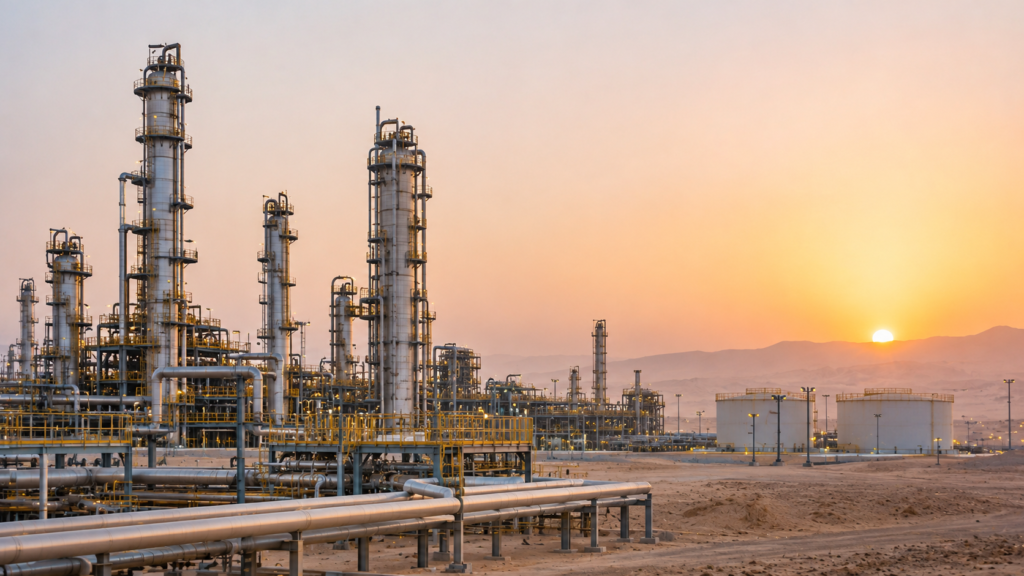
Iran-backed Houthi forces in Yemen have struck targets including the PIF tower, Riyadh’s airport and the country’s largest oil refinery, killing and injuring dozens. The risk forced the cancellation of the November investor conference often called “Davos in the Desert”.
Alibrahim said Saudi Arabia would “stop at nothing from realizing long-term sustainable stability in the region”. He said the attacks show why diversification matters for the economy. Jadaan said there was “no price tag or cap” on funds for the military if fighting demanded more.
What to watch next
- Fourth-quarter GDP data, which will show whether the ministry’s −2.1% estimate for 2026 holds.
- Which giga-projects are formally slowed or “warehoused”, as Jadaan put it, and how PIF reallocates its share of Vision 2030 spending.
- Whether the 2027 budget’s mix of Vision 2030 spending changes if oil revenue recovers faster or slower than planned.
- Detailed rules and start date for the 15% minimum tax on multinationals.
- Whether the 10.9% growth projection for 2027 survives if the conflict continues.
Sources
- Saudi Ministry of Finance: Budget 2027
- CNBC, 28 November 2026: interview with Economy Minister Faisal Alibrahim
- Zawya: Saudi Arabia approves 2027 budget (Finance Minister al-Jadaan briefing)
- MEED: detail from the 2027 budget statement
More from the region: Middle East & Africa and World Business News.
Disclaimer: The content published by Daily Business News is based on information compiled from publicly available sources. While reasonable efforts are made to ensure accuracy and reliability, Daily Business News does not warrant the accuracy, completeness, authenticity or timeliness of such information and shall not, to the extent permitted by applicable law, be liable for any errors, omissions, inaccuracies, misrepresentations or losses arising from reliance on the published content.
The content is intended solely for general informational purposes and does not constitute legal, tax, financial, investment, accounting or any other professional advice. Readers are advised to independently verify the information and seek appropriate professional advice before making any decisions.
This story follows our editorial policy. Spotted an error? Tell us.