L&T Finance FIR Quashed: Supreme Court Says Lender Holding Mortgaged Land Is a Creditor, Not a Trustee
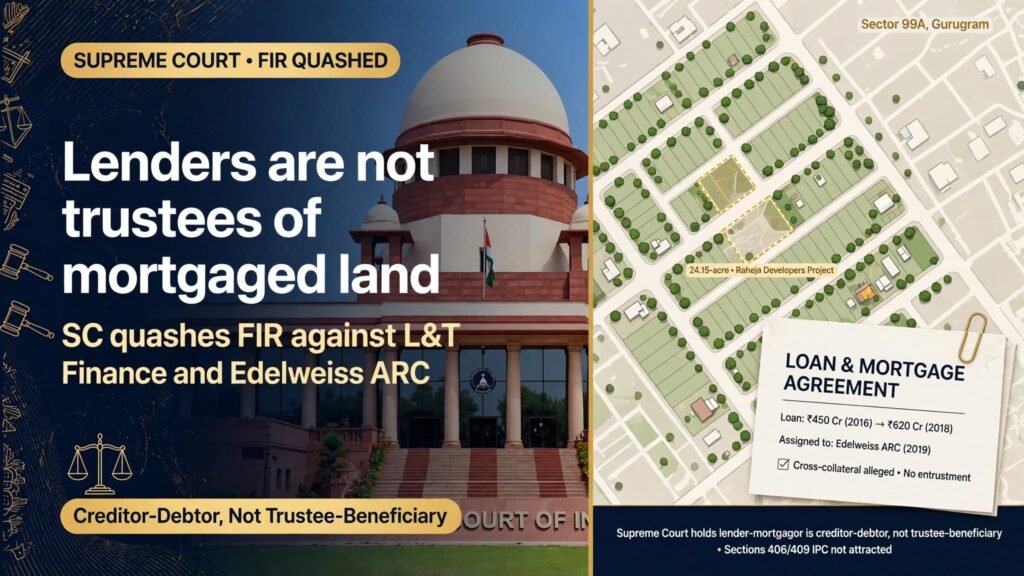
The Supreme Court has quashed the L&T Finance FIR over Gurugram land used as cross-collateral, holding that a lender that takes a mortgage for its own loan is a creditor, not a trustee. A bench of Justices Vikram Nath and Sandeep Mehta set aside a Delhi High Court ruling that had refused to end the criminal case against L&T Finance Limited and Edelweiss Asset Reconstruction Company Limited (EARC).
The judgment, Edelweiss Asset Reconstruction Company Ltd. v. State of NCT of Delhi & Ors. (2026 INSC 1236), is dated 29 September 2026 and was reported by LiveLaw on 19 November 2026 as 2026 LiveLaw (SC) 1178. It matters for landowners in joint development deals, NBFCs, asset reconstruction companies and developers who pledge project land.
Key Highlights
- The Supreme Court quashed FIR No. 0005 of 2025 under Sections 406, 409, 420 and 120B IPC, insofar as it relates to L&T Finance, EARC and their officers and employees.
- The Court held that a lender holding mortgage security for its own loan does not hold it “in trust”, so criminal breach of trust is not made out.
- No false representation was attributed to the lender, so the cheating charge also failed.
- RERA breaches by a promoter cannot ground a criminal case against a lender that is not the regulated entity.
- The Magistrate’s order directing the FIR, passed despite a police report finding no cognizable offence, was held to lack reasons.
- Proceedings against Raheja Developers Limited and other accused not before the Court continue.
What Happened in the L&T Finance FIR Case
The complainants own a 24.15-acre parcel in Sector 99A, Gurugram. Raheja Developers Limited (RDL) was developing a group housing project on it under a 2013 collaboration agreement, according to LawChakra’s report of the ruling.
The landowners alleged that their land was used as cross-collateral without consent, that the loan was enhanced without their knowledge, and that no-objection certificates for unit sales breached their agreements with RDL and the Real Estate (Regulation and Development) Act, 2016 (RERA).

How the Loan Was Structured
L&T Finance sanctioned RDL a loan of ₹450 crore in 2016. It was enhanced to ₹620 crore in 2018. The loan was secured by mortgages over four project lands, including the complainants’ licensed land.
In December 2019, the loan account and the securities were assigned to EARC. The assignment agreements are dated 30 December 2019, according to the judgment. The Court noted that the loan was sanctioned before the landowners signed their MoU with RDL.
Timeline of the Case
| Date | Event |
|---|---|
| 2016 | L&T Finance sanctions ₹450 crore loan to RDL |
| 2018 | Loan enhanced to ₹620 crore |
| 30 December 2019 | Loan account and securities assigned to EARC |
| 15 June 2022 | Landowners complain to the Economic Offences Wing (EOW), Delhi Police |
| 24 August 2022 | Landowners’ email offering to withdraw all cases for ₹80 crore |
| 15 January 2025 | Chief Judicial Magistrate, Saket, directs registration of FIR |
| 16 January 2025 | FIR No. 0005 of 2025 registered at PS EOW |
| 4 August 2025 | Delhi High Court refuses to quash the FIR |
| 29 September 2026 | Supreme Court quashes the FIR against the lenders |
How the Criminal Case Reached the Supreme Court
The EOW held a preliminary enquiry, found no cognizable offence and closed the complaint. The landowners then moved the Magistrate under Section 156(3) of the Code of Criminal Procedure, 1973 (CrPC). An Action Taken Report (ATR) from the police again said no cognizable offence was made out.
Despite the ATR, the Chief Judicial Magistrate, South District, Saket Courts, New Delhi, directed registration of an FIR on 15 January 2025 in CT Case No. 322 of 2024. The next day, the L&T Finance FIR was registered at PS Economic Offences Wing as FIR No. 0005 of 2025 under Sections 406, 409, 420 and 120B of the Indian Penal Code, 1860 (IPC).
The Delhi High Court, in a common judgment dated 4 August 2025 in CRL.M.C. Nos. 371 and 426 of 2025, refused to quash it. L&T Finance and EARC then appealed in Criminal Appeal Nos. 4622 and 4623 of 2026.
The Four Holdings of the Supreme Court
1. A Lender Is a Creditor, Not a Trustee
Criminal breach of trust under Section 405 IPC needs entrustment of property. The Court found the complaint did not allege that the land, or any interest in it, was entrusted to L&T Finance.
“A lender advancing a loan against security does not receive the security ‘in trust’,” the Court said in paragraph 58. The relationship, it said, “is that of creditor and debtor, not of trustee and beneficiary”. It concluded: “Since entrustment is absent, Sections 406 and 409 IPC are not attracted.”
On Section 409, which covers entrustment to a banker in the way of business, LiveLaw reported that the complaint named no officer to whom property was entrusted.
2. No Cheating by the Lender
Relying on Hridaya Ranjan Prasad Verma v. State of Bihar, the Court said a breach of contract is not cheating unless dishonest intent exists at the start. The FIR attributed the alleged false assurances to RDL, not to L&T Finance.
The Court added that imprudent lending, even if assumed, may expose a lender to financial loss or regulatory consequences. It also found it problematic to invoke breach of trust and cheating together on the same facts, since the two need inconsistent intent.
3. RERA Breaches Cannot Ground a Case Against the Lender
RERA obligations, including depositing 70% of amounts received from allottees in a separate account, fall on the promoter. The Court noted that Section 80 of RERA allows a court to take cognizance only on a written complaint by the Authority.
It held that RERA contraventions cannot sustain an IPC prosecution of a lender that is not the regulated entity. It described EARC as “a stranger to every transaction complained of” (paragraph 86(ii)).

4. Abuse of Process
The Court also found that continuing the L&T Finance FIR would be an abuse of the court’s process. The transactions dated from 2016 to 2019, but the complaint came only in 2022, after SARFAESI recovery proceedings had begun. The Court said criminal process cannot be used to give criminal colour to a civil or commercial dispute.
It also considered the landowners’ email of 24 August 2022 offering to withdraw the litigation against RDL, L&T Finance and EARC for ₹80 crore. Settlement attempts are not improper, the Court said, but the proposal “bears upon the true nature of the grievance” (paragraph 82).
What the Ruling Means for Landowners and Lenders
For lenders, NBFCs and ARCs, the quashing of the L&T Finance FIR confirms that holding mortgage security does not, by itself, make them trustees of the pledged land. A complaint must show actual entrustment and a dishonest representation by the lender.
For landowners in joint development or collaboration agreements, the judgment does not leave them without a remedy. Under paragraph 88(c), they may pursue civil, arbitral and statutory remedies, including against the lenders over the security interest the lenders claim.
The ruling protects only the two appellants. The judgment says proceedings against RDL and the other accused must continue according to law.
The Magistrate’s Duty When Rejecting a Police Report
The Court said an ATR is not a final report under Section 173 CrPC and does not bind the Magistrate, but it is not an empty formality. If the Magistrate disagrees, the order must show why.
“Such reasons need not be elaborate. But they must exist, and they must relate to the material,” the Court said in paragraph 46. In paragraph 47, it added: “An order that rejects the conclusion of the police on a mere ipse dixit cannot be tested.”
The Magistrate’s order referred only to “builders and developers” and said nothing about the role of L&T Finance or EARC. This gap in the order that led to the L&T Finance FIR was one reason the Court set it aside against the lenders. The Court also held that the High Court could not supply reasons the Magistrate had not recorded.
What Landowners Can Note Before Pledging Land
The facts of this case point to the questions a landowner may want answered before allowing land to be mortgaged for a developer’s loan. Did the lender make any representation to the landowner? Is the mortgage limited to one project, or can it serve as cross-collateral for others? Can the loan be enhanced without fresh consent?
The judgment shows that disputes on these points will usually be tested in civil, arbitral or RERA forums rather than through a police complaint against the lender. The L&T Finance FIR ruling also shows that RERA complaints against a promoter follow the route set by Section 80 of that Act.
Frequently Asked Questions
Why did the Supreme Court quash the L&T Finance FIR?
The Court found no entrustment of the land to the lender, so Sections 406 and 409 IPC did not apply. No false representation was attributed to L&T Finance, so cheating was not made out. It also held that continuing the case was an abuse of the court’s process.
Does a lender hold mortgaged land in trust for the landowner?
No. The Court held that a lender advancing a loan against security holds that security for its own loan. The relationship is that of creditor and debtor, not trustee and beneficiary. Criminal breach of trust needs entrustment, which a mortgage does not create by itself.
Is the case against Raheja Developers also closed?
No. The FIR was quashed only for L&T Finance, EARC and their officers and employees. The judgment says proceedings against Raheja Developers Limited and the other accused who were not before the Court continue and must proceed according to law.
What remedies do the landowners still have?
The Court allowed the landowners to pursue civil, arbitral and statutory remedies. This includes any remedy against L&T Finance and EARC over the security interest the lenders claim on the land. Only the criminal route against the lenders has been closed.
Sources
- Supreme Court judgment, Edelweiss Asset Reconstruction Company Ltd. v. State of NCT of Delhi & Ors. (PDF)
- LiveLaw: Lender Does Not Hold Mortgage Security In Trust For Borrower
- LawChakra: Supreme Court Quashes FIR Against L&T Finance, Edelweiss ARC
- Delhi High Court judgment dated 4 August 2025 (PDF)
Read more in Supreme Court news and Legal News.
This article is for general information only and is not legal, tax or financial advice.
This story follows our editorial policy. Spotted an error? Tell us.