US Threatens 40% China, Duty Proposes Section 301 Tariffs on 14 Economies Including India
The US Trade Representative has proposed Section 301 tariffs on 14 trading partners over alleged industrial overcapacity, including 25% on India and up to 40% on China if talks stall. Written comments close on 5 January 2027 ahead of hearings on 25 January 2027.
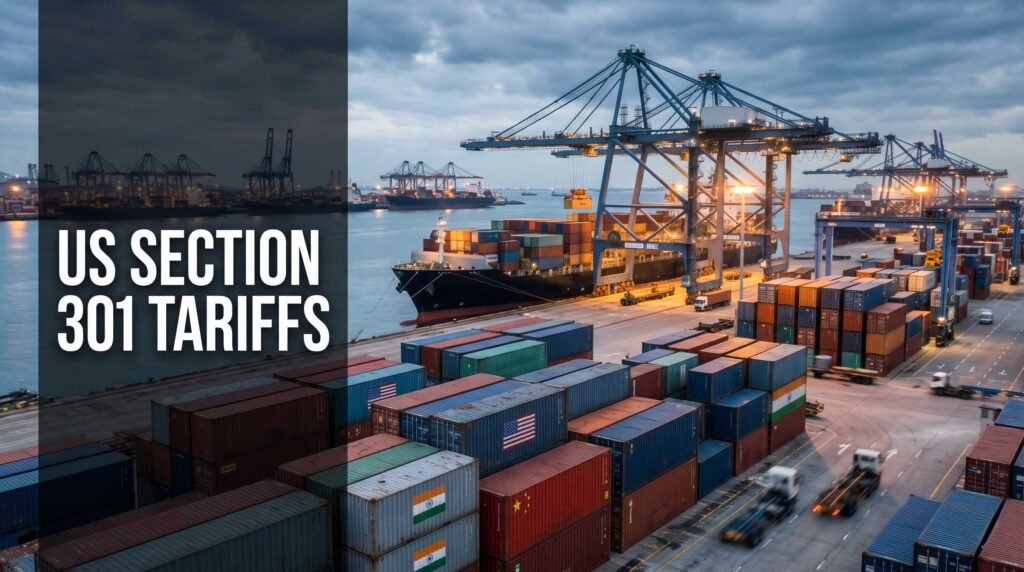
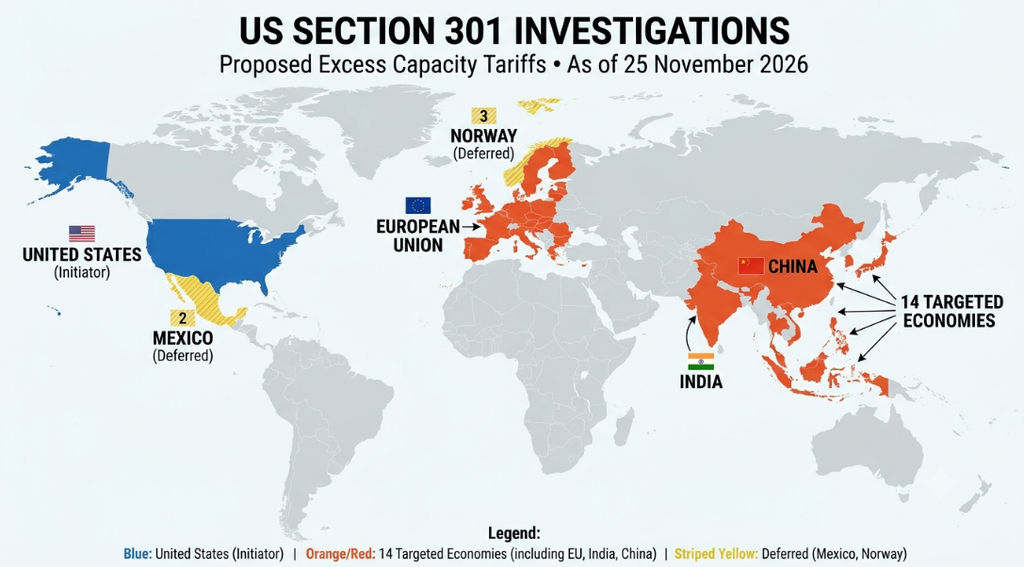
The United States has proposed broad Section 301 tariffs on 14 major trading partners, including a 25% levy on Indian goods and a threat of up to 40% duties on Chinese imports if bilateral negotiations stall. The Office of the United States Trade Representative (USTR) announced the affirmative determinations on 25 November 2026 following an eight-month probe into alleged structural excess manufacturing capacity. The proposed levies will not take effect immediately, with written public comments due by 5 January 2027 and public hearings scheduled to start on 25 January 2027.
Key Highlights
- 14 economies named: USTR Trade Representative Jamieson Greer determined that manufacturing capacity practices in Bangladesh, Cambodia, China, the European Union, India, Indonesia, Japan, Malaysia, Singapore, South Korea, Switzerland, Taiwan, Thailand and Vietnam burden US commerce.
- 40% China fallback threat: China faces a proposed ceiling of 20% on most goods—stacking on roughly 25% first-term duties—with a fallback rate of up to 40% if trade talks collapse.
- India’s dual rate: Indian goods face a proposed tariff of up to 25%, which could drop to 17% if New Delhi and Washington conclude a qualifying bilateral trade agreement.
- India rejects premise: India’s Ministry of Commerce and Industry said the notice is under examination, denied having structural excess capacity in any sector and reiterated its commitment to early trade talks.
- Section 232 carve-out: Pre-publication Federal Register notices for 13 economies, including India but excluding China, propose exempting goods already subject to US Section 232 tariffs such as steel, aluminium, vehicles and patented pharmaceuticals.
- Next deadlines: Stakeholders have until 5 January 2027 to file written comments, ahead of USTR hearings beginning on 25 January 2027 and expected implementation in early 2027.
Key Facts
| Item | Verified Detail |
|---|---|
| Authority | Office of the United States Trade Representative (USTR), headed by Jamieson Greer |
| Document and legal basis | USTR Notice of Determination and Request for Comments under Section 301(b) of the Trade Act of 1974 (19 U.S.C. 2411(b)) |
| Date issued | 25 November 2026 |
| Effective from | Not yet effective; final rates to be set after January 2027 hearings, expected in early 2027 |
| Deadlines | 5 January 2027 (written comments); 25 January 2027 (public hearings begin) |
| Applies to | Imports from 14 economies (Bangladesh, Cambodia, China, EU, India, Indonesia, Japan, Malaysia, Singapore, South Korea, Switzerland, Taiwan, Thailand and Vietnam); Mexico and Norway deferred |
What the Proposed Section 301 Tariffs Cover
In its 25 November 2026 announcement, USTR concluded that the acts, policies and practices of 14 economies relating to structural excess capacity and production in manufacturing sectors are “unreasonable and burden or restrict U.S. commerce”. USTR also released economy-specific reports backing each determination under Section 301(b) of the Trade Act of 1974.
The original investigations, initiated on 11 March 2026, covered 16 trading partners. USTR has deferred determinations on Mexico and Norway for now. According to an Alvarez and Marsal review of the pre-publication Federal Register notices, USTR gathered testimony from nearly 140 witnesses and 1,070 written comments during the inquiry.
How existing duties interact with the new proposals varies by partner. For the European Union, Japan, South Korea, Switzerland and Taiwan, the proposed rate is net of both most-favoured-nation (MFN) duties—the standard baseline tariff charged to WTO members—and existing Section 301 duties, creating an all-in ceiling. For the remaining partners, including India, the proposed rate is net of existing Section 301 duties only, meaning standard MFN duties would apply on top.
Pre-publication notices for 13 economies—every named partner except China—propose exempting goods already covered by US Section 232 national-security duties. Those carve-outs cover steel, aluminium, copper, derivative steel and aluminium goods, passenger vehicles, light trucks, medium- and heavy-duty vehicles and parts, wood products and patented pharmaceuticals, alongside listed annex goods.
China Faces Up to 40% Fallback Duty If Talks Stall
President Donald Trump’s administration structured the China proposal differently from all other partners. Under the pre-publication notice, China faces a capped levy of up to 20% on most imports, up to 10% on Annex A goods and an exemption for Annex B goods listed under the “30-For-30” US Imports List.
Because only the existing forced-labour Section 301 duty is netted out, the new 20% levy would stack on top of roughly 25% Section 301 duties imposed during Trump’s first term. As reported by Business Standard, the administration also proposed doubling the levy to a fallback rate of up to 40% across all Chinese goods if bilateral negotiations stall or Washington deems Beijing’s engagement inadequate.
The move came one week after Trump and Chinese President Xi Jinping met in Shenzhen during an Asia-Pacific gathering. Eleven of the 14 Federal Register notices carry similar higher fallback rates if consultations fail, with China facing the steepest fallback exposure ahead of a US-China trade truce expiring on 10 January.
Beijing rejected the findings. As quoted by The Indian Express, Chinese Foreign Ministry spokesperson Guo Jiakun dismissed “overcapacity” as a “false issue” and said China opposes using it as an excuse for political manipulation. On 26 November 2026, China also warned that it reserves the right to take “necessary measures” in response.
Proposed Rates for India, the EU, Japan and Other Partners
For India, USTR proposed a tariff of up to 25% following its twin Section 301 probes into alleged forced labour and industrial overcapacity. Because the rate is net of existing Section 301 levies, it is expected to absorb the 10% forced-labour duty imposed on Indian goods from 24 July 2026. USTR also offered to consider a reduced 17% rate if India signs a reciprocal bilateral trade agreement addressing the investigation’s findings.
According to The Indian Express, the USTR report on India pointed to the Make in India programme, production-linked incentives (PLI) and India’s growing reliance on Chinese industrial inputs, which USTR said nearly doubled between 2017 and 2025.
| Trading Partner | Proposed Base / Cap Rate | Deal Off-Ramp or Fallback Condition |
|---|---|---|
| China | Up to 20% (stacks on ~25% first-term duties) | Up to 40% fallback rate on all goods if talks stall or truce collapses |
| India | Up to 25% (net of existing 10% Section 301 duty) | 17% if India concludes a qualifying bilateral trade agreement |
| Vietnam | Up to 35% | 20% if Vietnam reaches a responsive agreement; probe also cited transshipment |
| European Union, Japan, South Korea | Capped at up to 15% under existing trade deals | All-in ceiling net of MFN and Section 301 duties; higher fallback threatened if deals falter |
| Singapore | Up to 20% | 10% proposed rate under a responsive agreement |
India’s Ministry of Commerce and Industry issued a response late on 25 November 2026 stating that the USTR notice is under examination. As reported by ThePrint, the ministry said the Department of Commerce had maintained throughout the proceedings that “India does not have structural excess capacity in any sector”, while reiterating New Delhi’s commitment to concluding the India-US bilateral trade agreement early.
Other major allies also pushed back. European Parliament trade committee chair Bernd Lange called Washington’s overcapacity allegations “absurd” and pressed the US to honour the 15% cap under the 2025 Turnberry agreement. Japan’s Chief Cabinet Secretary Minoru Kihara described the proposals as “regrettable” and denied that Japan maintains nonmarket policies or structural excess capacity.

Background: From Supreme Court Ruling to Section 301 Probes
The 25 November 2026 proposals mark a shift in the legal footing of US trade policy covered under our Global Economy desk. In February 2026, the US Supreme Court struck down most of Trump’s sweeping 2025 emergency-powers tariffs, prompting USTR to launch the 16-economy Section 301 investigations on 11 March 2026.
Unlike those emergency duties, Section 301 tariffs follow a statutory investigation, public comment and hearing process. Alvarez and Marsal noted that the US Supreme Court declined to review the Federal Circuit’s 2025 HMTX Industries ruling on 15 June 2026, leaving earlier first-term China tariff modifications intact. However, businesses and US states are currently challenging the administration’s forced-labour Section 301 duties in court.
For India, the proposal follows more than a year of shifting US tariff measures. After announcing a 25% tariff in July 2025 and an additional 25% penalty over Russian oil imports in August 2025, Washington reduced duties to 18% under a February 2026 trade framework before shifting to the 10% forced-labour Section 301 duty in July 2026. On 16 October 2026, Trump also waived a separate law threatening 100% tariffs on major buyers of Russian oil. Financial markets reacted sharply to the fresh 25 November announcement, with major US stock indexes opening over 1% lower and the Nasdaq Composite falling more than 3%.

What It Means for You
- Indian exporters to the US: Prepare for a potential tariff band ranging from 17% (if an India-US trade deal is finalised) to 25% (without a deal), plus standard MFN duties, starting in early 2027. Factor both scenarios into 2027 pricing and supply contracts.
- Exporters and industry associations seeking relief: The USTR proposal is not final. Affected Indian companies, export promotion councils and US importers can submit written comments by 5 January 2027 and track or participate in public hearings beginning on 25 January 2027.
- Steel, aluminium, auto and patented pharma exporters: Verify whether your products fall under the proposed Section 232 carve-out or annex exemptions once the formal Federal Register notices are published, as covered Section 232 items are proposed to be excluded from stacking for India.
- Manufacturers using Chinese inputs or relocated supply chains: Nearly every USTR determination cited non-market economy imports and investment, and the India report flagged rising reliance on Chinese inputs. Keep complete rules-of-origin records ready for stricter US Customs and Border Protection scrutiny.
- Trade, legal and compliance advisers: Monitor the final published Federal Register notices, progress on the India-US bilateral trade agreement and pending US court challenges to the forced-labour Section 301 duties before advising clients on long-term sourcing shifts.
Frequently Asked Questions
When will the proposed Section 301 tariffs take effect?
The proposed duties are not yet in force. Written public comments are due by 5 January 2027, and the Office of the United States Trade Representative will begin public hearings on 25 January 2027. Final rates will be decided only after those hearings conclude, with implementation expected in early 2027.
How can India reduce its proposed 25% US tariff rate to 17%?
The USTR notice proposes considering a reduced tariff rate of 17% for Indian imports if New Delhi and Washington conclude a reciprocal bilateral trade agreement addressing the investigation’s findings. India’s Ministry of Commerce and Industry has rejected the excess capacity charge while reaffirming its commitment to concluding the bilateral pact early.
Which Indian export sectors are proposed to be exempt from these duties?
According to pre-publication Federal Register notices analysed by Alvarez and Marsal, goods already subject to US Section 232 tariffs are proposed for exemption for 13 economies including India. These cover steel, aluminium, copper, derivative metal products, passenger vehicles, trucks and parts, wood products and patented pharmaceuticals, along with specific annex items.
Why could US tariffs on Chinese goods rise to 40%?
Under the USTR proposal, China faces a capped 20% tariff on most goods, stacking on top of roughly 25% first-term Section 301 duties. However, pre-publication notices include a fallback rate of up to 40% on all Chinese goods if bilateral trade talks stall or the current US-China truce breaks down.
Sources
- Office of the United States Trade Representative — Press Release on 14 Section 301 Structural Excess Capacity Determinations (25 November 2026)
- The Indian Express — Tariffs come full circle: How Trump’s Section 301 tariffs restore duties struck down by US top court (26 November 2026)
- Business Standard — Trump seeks to keep leverage over Xi with 40% China tariff threat (26 November 2026)
- Alvarez and Marsal — USTR’s Excess Capacity Determinations: Section 301 Moves to the Center of U.S. Tariff Policy (26 November 2026)
This article is for general information only and is not legal, tax or financial advice.
This story follows our editorial policy. Spotted an error? Tell us.