Personal Guarantor Insolvency Triggered by Default Date, Not NPA Date: NCLT Allahabad Admits ICICI Bank Plea
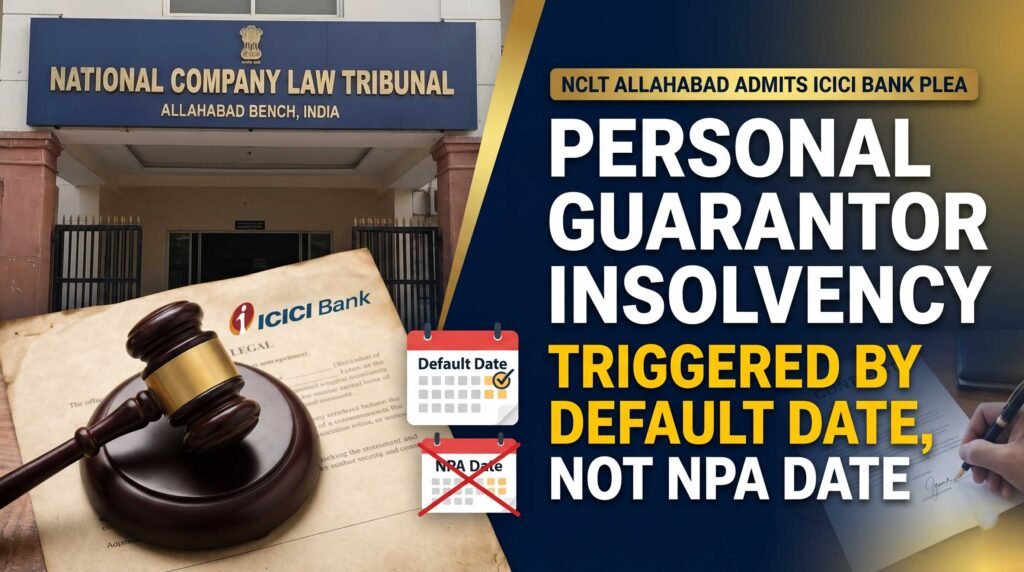
Personal guarantor insolvency under the Insolvency and Bankruptcy Code, 2016 (IBC) is triggered by the date of default, not the date the lender classifies the loan as a non-performing asset (NPA), the National Company Law Tribunal (NCLT), Allahabad Bench, has held. The Tribunal admitted ICICI Bank’s application under Section 95 of the IBC against Divya Singh, personal guarantor to Ossify Industries Private Limited, and started the Personal Insolvency Resolution Process (PIRP) against her.
The order in ICICI Bank Ltd. v. Divya Singh, CP (IB) No. 85/ALD/2025, was passed by Judicial Member Praveen Gupta and Technical Member Ashish Verma. LiveLawBiz reported it on 19 November 2026 as 2026 LLBiz NCLT (ALL) 1147. The text of the order published by IBC Laws gives the order date as 4 November 2026.
Key Highlights
- NCLT Allahabad held that the “date of default” and the “date of NPA” are distinct, and the IBC is triggered by default.
- A gap between the default date (2 January 2024) and the NPA date (15 February 2024) did not defeat the Section 95 application.
- The Tribunal relied on the authenticated NeSL record of default.
- The application was within three years of the guarantee being invoked on 29 April 2024.
- A defect in service of the demand notice was cured by a supplementary affidavit.
- PIRP was initiated against the guarantor, a moratorium was declared, and Anil Kohli was appointed Resolution Professional (RP).
Facts of the Personal Guarantor Insolvency Case
ICICI Bank sanctioned Ossify Industries a cash credit facility of Rs. 10.60 crore under a Credit Arrangement Letter (CAL) and Facility Agreement dated 24 September 2021. On the same date, Divya Singh signed a Deed of Guarantee making her jointly and severally liable for the dues.
The limit was reduced to Rs. 4.60 crore under a CAL dated 22 December 2023, at the company’s request. The duration was modified on 9 February 2024. The bank’s application stated the date of default as 2 January 2024, and the account was classified as an NPA on 15 February 2024.
After the NPA classification, the company made part payments of about Rs. 97.92 lakh between 16 February 2024 and 17 August 2024. The amount in default stated in the order is Rs. 4,86,80,753.30.
Timeline of the Case
| Date | Event |
|---|---|
| 24 September 2021 | Rs. 10.60 crore cash credit sanctioned; Deed of Guarantee signed |
| 22 December 2023 | Limit reduced to Rs. 4.60 crore |
| 2 January 2024 | Date of default stated in the application |
| 15 February 2024 | Account classified as NPA |
| 29 April 2024 | Loan recall and invocation of personal guarantee |
| 24 May 2024 | Demand notice under Section 13(2) of the SARFAESI Act |
| 27 February 2025 | Demand notice in Form B under Rule 7(1) |
| 9 June 2025 | Section 95 application filed |
| 23 August 2025 | RP’s report recommending admission |
| 4 November 2026 | NCLT admits application and initiates PIRP |
The bank also issued a composite loan recall and guarantee invocation on 29 April 2024 for Rs. 4,11,03,094.30 as on 1 April 2024. It filed a recovery case, O.A. No. 479 of 2024, before Debts Recovery Tribunal-II, New Delhi.
The Guarantor’s Objections
According to the order, the guarantor raised several objections to the personal guarantor insolvency application, recorded in paragraph 25. The three main ones were:
- Wrong addressee: the Form B demand notice was allegedly issued to Sandeep Kumar instead of her.
- RP’s report: the RP allegedly relied on the bank’s figures without independent application of mind.
- Date mismatch: the default date did not match the NPA date, and the NeSL certificate was dated 15 April 2024.
She also cited the parallel Section 7 case against the company and the DRT proceedings, and argued that the company was viable.
Default Date vs NPA Date: How the Tribunal Answered
The Tribunal held that a default occurs when a debt falls due and remains unpaid. NPA classification is a separate step under Reserve Bank of India norms, taken when an asset stops generating income. It ordinarily follows the default and cannot override the actual default date.
“The cause of action under the IBC is triggered by the ‘default’ and not by the NPA classification,” the Tribunal said in paragraph 37. It also recorded that “‘Date of Default’ and ‘Date of NPA’ are distinct concepts”.
The Tribunal relied on the Supreme Court’s rulings in Laxmi Pat Surana v. Union Bank of India and B. Prashanth Hegde v. SBI. It agreed with the RP’s reliance on the NeSL record.
The Other Objections
Demand notice: A supplementary affidavit dated 8 August 2025 showed that the Form B notice was served on Divya Singh. The Tribunal held the defect rectified (paragraph 42).
RP’s role: Citing Dilip B. Jiwrajka v. Union of India, the Tribunal said the RP’s role under Section 99 is facilitative and recommendatory. Adjudication lies with the Tribunal under Section 100 (paragraph 43).
Parallel proceedings: The Section 7 objection was rejected because the Tribunal had already ordered a corporate insolvency resolution process against Ossify Industries on 17 September 2026 (paragraph 38).

Role of the NeSL Record in Personal Guarantor Insolvency
The guarantor had argued that the NeSL certificate, dated 15 April 2024, did not fit the bank’s NPA date. The Tribunal found the NeSL record of default authenticated and treated it as confirming the company’s default. Disputing the record at a later stage was treated as an afterthought (paragraph 32). LiveLawBiz reported that the Tribunal found the default conclusively established on this basis.
Limitation and the Guarantee
The guarantee was invoked on 29 April 2024, and the application was filed on 9 June 2025. The Tribunal held this was within three years under Article 137 of the Limitation Act, 1963 (paragraphs 27 to 29).
On liability, the Tribunal relied on Section 128 of the Indian Contract Act, 1872, under which a guarantor’s liability is co-extensive with the borrower’s. It described the guarantee as absolute, unconditional and irrevocable (paragraph 45).
What the Order Directs
The Tribunal admitted the application and initiated PIRP against Divya Singh, with Anil Kohli as the RP. It declared a moratorium under Section 101, which ends after 180 days or when a repayment plan order is passed under Section 114, whichever is earlier.
With the personal guarantor insolvency process now under way, the RP must publish a public notice under Section 102 within seven days, inviting claims within 21 days. The RP must also prepare the list of creditors, work with the debtor on a repayment plan and file progress reports every 30 days. The matter is next listed on 7 December 2026.
The order also records that costs of Rs. 15,000 were imposed on the guarantor on 3 February 2026 for not filing a reply.
What Promoters Should Know Before Signing a Guarantee
SME promoters often sign personal guarantees for their company’s working capital loans. This order shows how the NCLT reads such guarantees in a personal guarantor insolvency case.
- The trigger is the default date, which can come weeks before the NPA date. A mismatch between the two did not help the guarantor here.
- For limitation, the Tribunal counted three years from invocation of the guarantee.
- An authenticated NeSL record carried weight, and a late challenge to it was rejected.
- A pending recovery case before the DRT or a Section 7 case against the company did not stop the Section 95 application.
- Once admitted, the moratorium bars new legal actions and transfer or encumbrance of the guarantor’s assets during the process.
Frequently Asked Questions
What did NCLT Allahabad decide in ICICI Bank v. Divya Singh?
The Tribunal admitted ICICI Bank’s Section 95 application and initiated PIRP against Divya Singh, guarantor to Ossify Industries. It held that the IBC is triggered by the date of default, not the date of NPA classification, and rejected her objections on dates, service of notice and the RP’s report.
Does the NPA date decide when personal guarantor insolvency can start?
No. In this case, the Tribunal held that default and NPA are distinct concepts. A default happens when a debt falls due and is unpaid. NPA classification under RBI norms ordinarily comes later and cannot override the actual default date.
How was limitation counted in this personal guarantor insolvency case?
The Tribunal counted three years from the invocation of the guarantee on 29 April 2024 under Article 137 of the Limitation Act, 1963. The application filed on 9 June 2025 was held within limitation and maintainable. Invocation was also within three years of the company’s default.
What happens after a PIRP is admitted?
A moratorium under Section 101 applies. Pending legal actions are stayed, new actions cannot be started, and the debtor cannot transfer or encumber assets. The RP invites claims, prepares a list of creditors and works with the debtor on a repayment plan for creditors to consider.
Sources
- LiveLawBiz: IBC Default Date, Not NPA Classification, Triggers Insolvency Against Personal Guarantor
- NCLT Allahabad order, ICICI Bank Ltd. v. Divya Singh (PDF)
- IBC Laws: ICICI Bank Ltd. v. Divya Singh, NCLT Allahabad
Read more in NCLT and NCLAT news and Legal News.
This article is for general information only and is not legal, tax or financial advice.
This story follows our editorial policy. Spotted an error? Tell us.