SEBI FPI Disclosure Rules: Proposal to Remove Additional Reporting for Foreign Investors
SEBI has proposed withdrawing the Additional Disclosure Framework for foreign portfolio investors, including related requirements for ODI subscribers and segregated portfolios. Existing beneficial ownership checks would remain applicable. Public comments are invited until 11 December 2026.

The SEBI FPI disclosure rules could undergo a significant change after the Securities and Exchange Board of India (SEBI) proposed withdrawing its Additional Disclosure Framework (ADF) for Foreign Portfolio Investors (FPIs). The regulator issued its consultation paper on 20 November 2026 and invited public feedback by 11 December 2026. The proposal would reduce additional reporting obligations without eliminating ordinary beneficial ownership checks.
Key Highlights
- SEBI has proposed removing the ADF for FPIs, including corresponding requirements for offshore derivative instrument subscribers and segregated portfolios.
- The proposal covers additional disclosures linked to portfolio concentration and investment size.
- Existing customer due diligence and beneficial ownership identification requirements are distinct from the ADF.
- SEBI cites compliance costs, international regulatory differences and changes to India’s foreign direct investment policy.
- The consultation closes on 11 December 2026. No final repeal has been verified as of 27 November 2026.
Key Facts
| Particulars | Details |
|---|---|
| Authority | Securities and Exchange Board of India |
| Document | Consultation Paper on proposal to review the Additional Disclosure Framework for Foreign Portfolio Investors |
| Date issued | 20 November 2026 |
| Public comment deadline | 11 December 2026 |
| Legal framework | Regulations 22(6) and 22(7) of the SEBI (Foreign Portfolio Investors) Regulations, 2019 |
| Regulatory status | Consultation proposal; no effective date announced |
What SEBI FPI Disclosure Rules Would Change
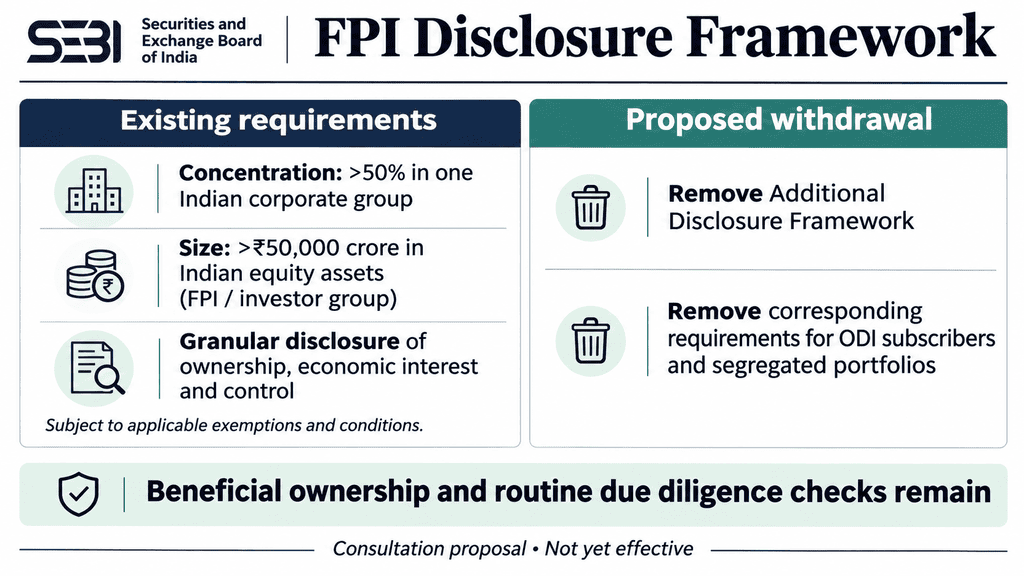
Paragraphs 5.1 and 5.2 of the consultation paper recommend eliminating the additional reporting framework, rather than merely increasing its thresholds. The proposed withdrawal also extends to the ADF obligations of subscribers to offshore derivative instruments (ODIs) and segregated portfolios maintained by FPIs.
An ODI provides exposure to securities through an instrument issued offshore. A segregated portfolio is a distinct pool within a fund structure. The proposed changes concern additional disclosure requirements applicable to these arrangements, not the abolition of their broader regulatory framework.
SEBI FPI Disclosure Rules: Existing Thresholds and Legal Basis
SEBI introduced the ADF through amendments to its FPI Regulations and Circular SEBI/HO/AFD/AFD-PoD-2/CIR/P/2023/148 dated 24 August 2023. Its operation is linked to Regulations 22(6) and 22(7).
Paragraph 2.7 of the November consultation describes two principal triggers, subject to applicable exemptions and specific conditions:
| Criterion | General threshold described by SEBI |
|---|---|
| Concentration | More than half of an FPI’s Indian equity portfolio by value invested in one Indian corporate group. |
| Size | Indian equity assets exceeding ₹50,000 crore, assessed for the FPI alone or together with its investor group. |
The size threshold was originally ₹25,000 crore and was doubled on 9 April 2025. Qualifying pooled funds and certain government-related investors can receive conditional exemptions.
The additional reporting layer traces ownership, economic interests and control through successive entities to individual persons, irrespective of the size of their interest. It therefore requires information beyond that collected through routine beneficial ownership checks.
Why SEBI Wants to Withdraw the Framework
SEBI identifies several operational problems in paragraph 4.1. Global funds may incur costs establishing India-specific investment vehicles, gathering information from numerous investors and revisiting ownership records as investors enter or leave pooled structures.
The regulator also reports net equity withdrawals exceeding ₹5.61 lakh crore between October 2024 and October 2026. It acknowledges that several factors may explain the outflows. The paper does not establish that the disclosure regime alone caused foreign investors to sell Indian shares.
According to SEBI, the burden of additional reporting can discourage investors from entering the Indian market. Its review is intended to improve India’s competitiveness for international capital without abandoning the underlying anti-money laundering framework.
How the 2026 FDI Policy Review Affects the Proposal
SEBI also connects the proposed withdrawal to Press Note 2 of 2026, dated 15 March 2026. As explained in paragraphs 4.3 to 4.5, the government clarified beneficial ownership criteria for investments covered by the earlier Press Note 3 restrictions concerning countries sharing a land border with India.
SEBI considers the revised ownership criteria more closely aligned with the checks already applicable to FPIs. This forms part of its rationale for reconsidering the size-based reporting requirement. It does not amount to a general exemption from foreign investment restrictions.
Will Beneficial Ownership Disclosure End?
No. Rule 9(3) of the Prevention of Money Laundering (Maintenance of Records) Rules, 2005 provides the underlying framework for identifying beneficial owners. SEBI’s paper describes ownership thresholds of 10% or 15%, depending on the client’s legal structure, alongside applicable control-based criteria.
The distinction is between routine client verification and additional threshold-triggered reporting. Removing the latter would not, by itself, change the former. SEBI also notes that any review of the money laundering rules falls within the Ministry of Finance’s jurisdiction.
The policy trade-off concerns transparency. As The Indian Express explained on 23 November 2026, less granular reporting could make it harder to establish ultimate interests in certain complex offshore structures. The challenge is to reduce administrative burdens while retaining safeguards against opaque ownership and regulatory circumvention.
What It Means for You
- Foreign portfolio investors: The SEBI FPI disclosure rules have not been withdrawn merely because the consultation paper was issued. Applicable reporting requirements continue pending an operative change.
- ODI subscribers and segregated portfolios: The proposed relief is limited to their ADF-related obligations; the paper does not announce a general exemption.
- Custodians and compliance teams: Existing due diligence and beneficial ownership checks are unaffected by the consultation itself.
- Market participants: Feedback can be submitted through SEBI’s public consultation portal by 11 December 2026.
Related coverage: SEBI’s review of the margin trading facility framework.
Frequently Asked Questions
Has SEBI scrapped the additional FPI disclosure framework?
No. The document issued on 20 November 2026 invites views on withdrawal of the framework. The consultation is not an implementing circular or regulatory amendment. As of 27 November 2026, no final repeal has been verified, and the paper does not provide an effective date.
What is the ₹50,000 crore threshold under the SEBI FPI disclosure rules?
It is the general size-based trigger described in the consultation for additional disclosure of underlying interests. The assessment takes account of the FPI’s Indian equity assets and, where applicable, those of its investor group. It is a reporting criterion, not an overall investment ceiling.
Will FPIs still have to identify their beneficial owners?
Yes. The proposed removal targets the separate ADF layer. The consultation distinguishes this layer from identification of beneficial owners under Rule 9(3) of the Prevention of Money Laundering (Maintenance of Records) Rules, 2005. Ordinary client verification requirements would not automatically disappear if SEBI implements its proposal.
When is the deadline to submit comments to SEBI?
The deadline is 11 December 2026, as specified in paragraph 6.1 of the consultation paper. Stakeholders can respond using the online public comment form linked in the official document. The deadline is for consultation feedback and should not be confused with an implementation date.
Sources
- SEBI: Consultation paper, 20 November 2026 (primary document)
- SEBI: Original additional disclosure circular, 24 August 2023
- The Indian Express: FPI disclosure relief, 23 November 2026
Read more SEBI regulatory news.
This article is for general information only and is not legal, tax or financial advice.
This story follows our editorial policy. Spotted an error? Tell us.