Videocon Insolvency: Supreme Court Upholds NCLAT, Says Dissenting Lenders Must Be Paid in Money, Not Debentures
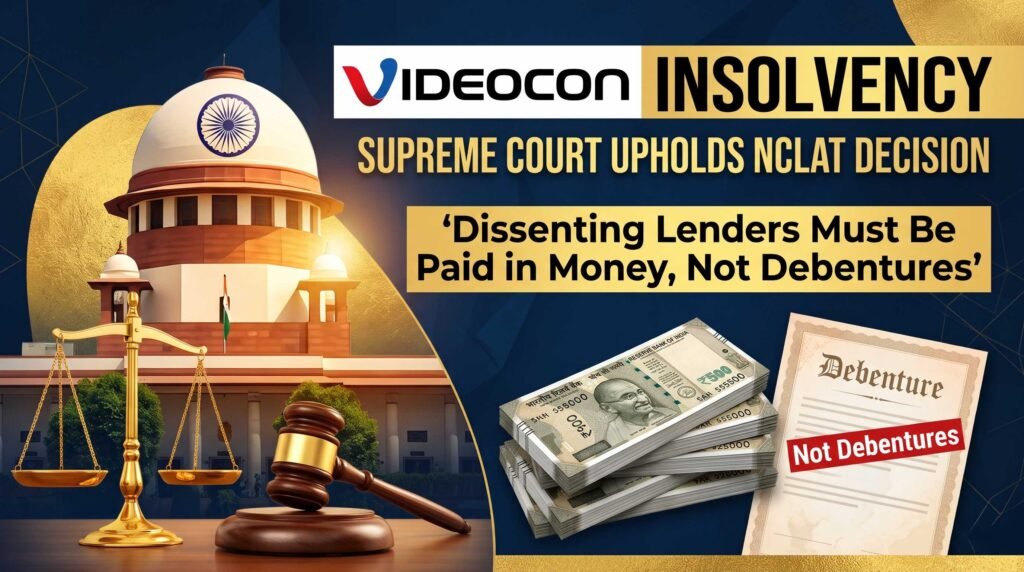
The Supreme Court on Monday, 16 November 2026, dismissed appeals filed by Vedanta group company Twinstar Technologies Ltd and upheld the National Company Law Appellate Tribunal’s (NCLAT) decision to send its resolution plan for Videocon Industries Ltd and 12 group companies back to lenders. The Videocon resolution plan Supreme Court ruling holds that dissenting financial creditors must receive payment in money, not long-term debentures.
Key Highlights
- The Supreme Court on 16 November 2026 dismissed Twinstar Technologies’ appeals and upheld the NCLAT’s 5 January 2022 order setting aside approval of its ₹2,962.02 crore plan for 13 Videocon group companies.
- The matter goes back to the Committee of Creditors (CoC), which may consider a modified plan or invite fresh bids.
- Dissenting financial creditors must be paid in money under Section 30(2)(b) of the IBC; non-convertible debentures (NCDs) redeemable over up to six years do not qualify.
- The NCLT cannot rewrite a CoC-approved plan to cure a defect.
- The Court laid down five safeguards for NCLAT remands and held that the CoC was not functus officio.
- Overseas oil and gas assets held through Videocon Industries’ subsidiaries stay outside its insolvency estate.
A bench of Justice Pamidighantam Sri Narasimha and Justice Alok Aradhe delivered the judgment in Twinstar Technologies Ltd v. Bank of Maharashtra & Ors (2026 INSC 1214). While pronouncing the verdict, the bench said it had upheld the NCLAT’s power to send an approved plan back to the CoC and had dismissed all the appeals.
Videocon Resolution Plan Supreme Court Ruling: Key Figures
Twinstar’s amended plan was approved by creditors holding 95.09% of the CoC’s voting share on 11 December 2020. Four financial creditors, holding about 3.077% of the voting share, voted against it.
- Total plan outlay: ₹2,962.02 crore
- Admitted claims: ₹64,838.63 crore
- Haircut recorded by the NCLT: 95.85%
- Liquidation value: ₹2,568.13 crore
- Upfront payment to financial creditors: ₹200 crore
- NCDs to financial creditors: face value ₹2,700 crore, 6.65% annual coupon, redeemable in five instalments starting 25 months after closing and running into the sixth year
- Upfront payment to operational creditors: ₹10 crore
- Recovery for operational creditors: 0.72% of admitted claims, as per NCLT figures
Why Debentures Failed the “Payment in Money” Test
Section 30(2)(b) of the Insolvency and Bankruptcy Code, 2016 guarantees dissenting financial creditors a minimum payment linked to what they would receive in liquidation under Section 53(1). Relying on the three-judge bench ruling in Jaypee Kensington Boulevard Apartments Welfare Association v. NBCC (India) Ltd, the Court held that this payment must be in money.
A plan that discharges dissenters, in substance, through debentures redeemable over six years does not provide for “payment” under the provision, the Court held. It added that the plan also failed to give dissenters the priority over assenting financial creditors required by Regulation 38(1)(b) of the CIRP Regulations.
Twinstar had relied on a clause in its plan promising compliance with Section 30(2)(b). The Court rejected this, holding that compliance must be found in the plan’s terms, “and not in an undertaking to comply”.
NCLT Cannot Rewrite a CoC-Approved Plan
The NCLT’s Mumbai bench approved the plan on 8 June 2021 but directed that dissenting financial creditors be paid their liquidation entitlement in cash, upfront, before assenting lenders. The Supreme Court held that this direction changed the allocation and order of the ₹200 crore earmarked for financial creditors and therefore amounted to a modification of the plan.
Altering a plan is a commercial decision for the CoC through its voting process, the Court held, and the adjudicating authority could not cure the defect itself. Neither the NCLT nor the NCLAT can substitute its commercial judgment for that of the creditors.
Five Safeguards for NCLAT Remands
The Court upheld the NCLAT’s power to remand an approved plan to the CoC and set out five considerations for its use:
- Advance the Code’s objectives: keeping the corporate debtor a going concern, fair recovery for all creditor classes and maximising asset value.
- Legal non-compliance: remand must rest on a finding that the plan breaches Section 30(2) or another law in force, a ground of appeal under Section 61(3)(i).
- Sparing use: the power is to be used with caution and cannot depart from any express procedure in the Code.
- Corrective function: where the NCLT modifies a plan instead of returning it to the CoC, the NCLAT may remand it to restore the proper roles.
- Strict timelines: every remand order must direct strict adherence to statutory and regulatory timelines.
According to Bar & Bench, the Court said the power must be exercised in a manner that “secures its benefit by incurring the least potential costs”.
CoC Not Functus Officio
Twinstar argued that the CoC’s role ended once it approved the plan, relying on Ebix Singapore. The Court rejected this, holding that the CoC continues its statutory role until a plan is implemented or liquidation is ordered.
Here, the approval had not attained finality because it was under statutory appeal and had been stayed by the NCLAT in July 2021. Creditors holding about 94.98% of the voting share later told the appellate tribunal they wished to reconsider the plan. The Court distinguished Ebix, which concerned a resolution applicant seeking to withdraw or modify its own plan.
The Court did not limit reconsideration to Twinstar’s plan. Whether to consider a modified plan or invite fresh bids is for the CoC to decide.
Side Rulings: CCI, Subsidiary Assets and Operational Creditors
On one point, the Court ruled in Twinstar’s favour. The NCLAT had held that prior Competition Commission of India (CCI) approval under the proviso to Section 31(4) was not obtained. The Supreme Court found that a CCI communication dated 8 December 2020 preceded the close of CoC voting on 11 December 2020. The remand stands on the other grounds.
The Court rejected former promoter Venugopal Dhoot’s plea to include oil and gas interests in Brazil and Indonesia, held through Videocon subsidiaries, in Videocon Industries’ insolvency. Citing Explanation (b) to Section 18 and Section 36(4)(d) of the Code, it held that a holding company and its subsidiary are separate legal persons and that subsidiary assets are not the parent’s property merely because of share ownership. It also declined to interfere with Bharat PetroResources Ltd’s right of first refusal over the Brazilian interest, a transfer that has since been completed.
The appeal of the VIL Vendors Association, representing operational creditors, was dismissed. The Association was given liberty to pursue remedies available under law, including where Videocon Industries parted with rights or gave guarantees without consideration. GAIL (India) Ltd’s claim will be dealt with by the resolution professional.
What the Ruling Lays Down for Pending CIRPs
The Videocon resolution plan Supreme Court judgment sets out the following positions under the Code:
- Dissenting financial creditors: their Section 30(2)(b) entitlement must be paid in money, with priority over assenting financial creditors.
- Resolution applicants: a general clause promising legal compliance does not substitute for specific payment terms in the plan.
- Adjudicating authority: the NCLT cannot modify a CoC-approved plan; a defective plan goes back to the CoC.
- Committee of Creditors: it may reconsider a plan whose approval is under appeal and legally defective.
- Operational creditors and vendors: challenges to improper transactions must follow the routes provided under the Code.
Background
The insolvency proceedings of Videocon Industries and 12 group companies were consolidated by an order dated 8 August 2019. Dissenting lenders Bank of Maharashtra, IFCI Ltd and Small Industries Development Bank of India (SIDBI) challenged the NCLT’s June 2021 approval before the NCLAT, which set it aside on 5 January 2022. Twinstar then moved the Supreme Court, which has now decided the Videocon resolution plan dispute nearly six years after the CoC vote.
Disclaimer
This article is based on information available from public sources and official statements as on 17 November 2026. It is published for general information only and does not constitute financial, investment or legal advice. DailyBusinessNews does not guarantee the completeness of the information and is not responsible for any decision taken on its basis. Readers should verify details with official sources.
This story follows our editorial policy. Spotted an error? Tell us.