RBI Sets 7-Day Window to Explain Flagged Transactions Under Temporary Debit Hold Rules for Banks
RBI's final money mule directions give customers seven calendar days to explain a flagged transaction. Banks then get seven days to lift the temporary debit hold or report the case to police. The rules apply from 1 July 2027.
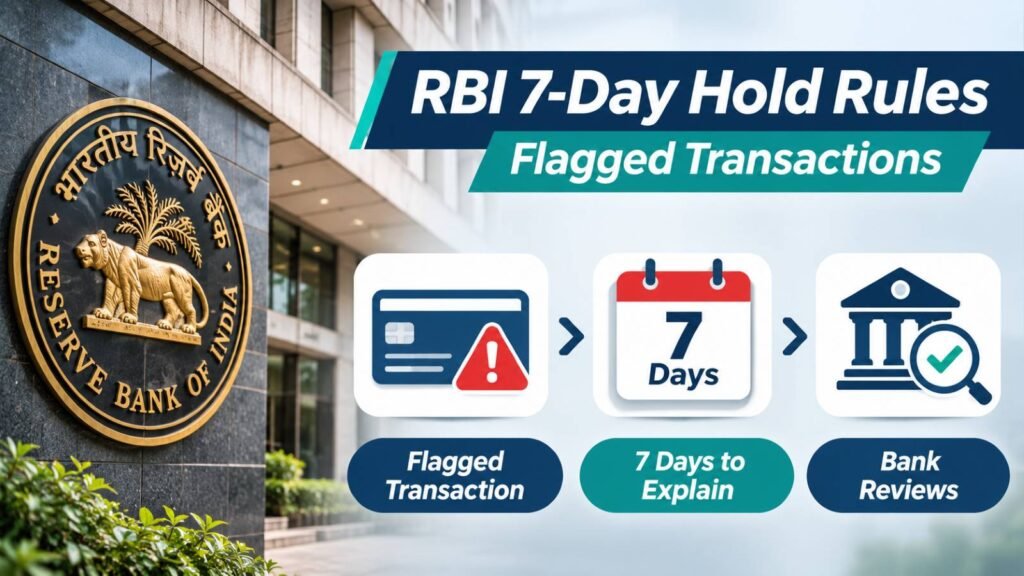
Banks will soon follow a fixed clock when they place a temporary debit hold on money they suspect is passing through a money mule account. Under final directions issued by the Reserve Bank of India on 27 November 2026, a customer gets seven calendar days to explain a flagged transaction, and the bank then gets seven calendar days to lift the hold or report the matter to the police.
Key Facts
| Item | Detail |
|---|---|
| Authority | Reserve Bank of India |
| Document and number | Reserve Bank of India (Commercial Banks – Know Your Customer) Second Amendment Directions, 2026 and five parallel directions; Press Release 2026-2027/1584 |
| Date issued | 27 November 2026 |
| Effective from | 1 July 2027, or an earlier date if a bank chooses to implement the SOP sooner |
| Deadline | Customer: 7 calendar days to explain. Bank: 7 calendar days from receiving the explanation to decide |
| Applies to | Commercial banks, small finance banks, payments banks, local area banks, regional rural banks and urban co-operative banks |
What Has RBI Issued, and Why?
The RBI issued six sets of amendment directions, one for each type of bank, under its Know Your Customer (KYC) framework. Each carries the same standard operating procedure (SOP) on suspected money mule accounts. A money mule account is one used, knowingly or not, to receive or move money linked to fraud on someone else’s behalf.
According to the RBI press release, the SOP lets banks place a temporary debit hold on amounts or accounts suspected of links to money mule activity or cyber-enabled fraud. The holds are to be removed in coordination with law enforcement agencies, while avoiding inconvenience to genuine customers.
The final text follows a draft released on 11 September 2026. The RBI said it examined the feedback on that draft and built the resulting changes into the final directions.
When Can a Bank Place a Temporary Debit Hold?
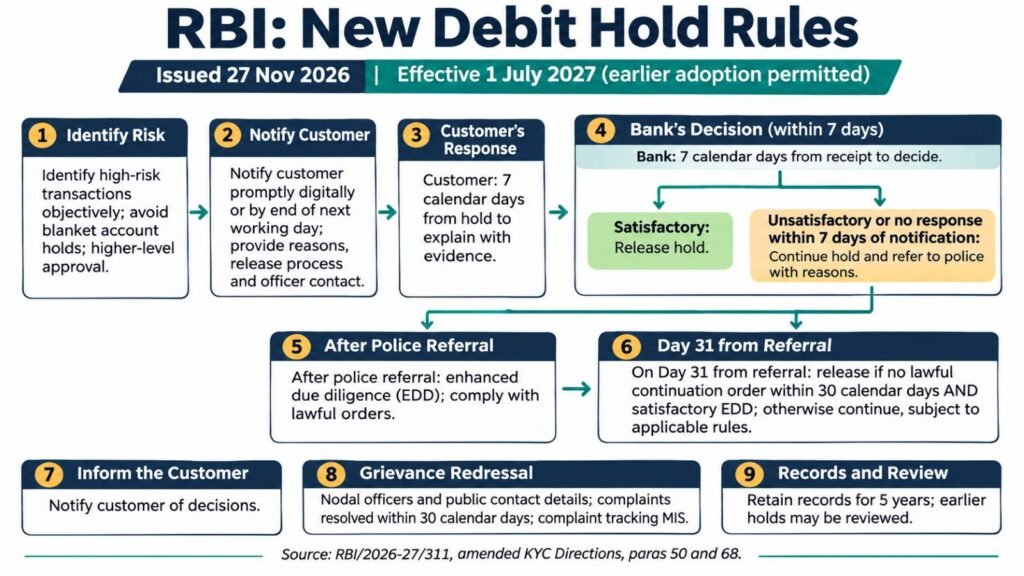
As reported by ANI, the directions cover highly suspicious transactions and accounts linked to money mule activity, cyber-enabled financial fraud and terrorist financing. Banks must use technology and other tools that flag such activity on objective parameters, while keeping the risk of wrongly flagging genuine accounts low.
A bank may hold either the suspicious amount or the whole account, with approval “at an appropriately higher level”. The RBI has also said that the “mechanical application of hold at account level shall be avoided”.
How Will Customers Be Told About a Temporary Debit Hold?
The bank must inform the customer promptly through digital channels. Where it uses other modes, the notice must reach the customer by the end of the next working day.
The notice must state:
- the reasons for the restriction;
- the process to have it removed; and
- the contact details of the bank officer handling the case.
How Long Can a Temporary Debit Hold Last?
The SOP runs in three time-bound stages, as reported by ANI:
- Customer explanation: the account holder gets seven calendar days to submit an explanation and supporting documents.
- Bank decision: the bank must decide promptly, and no later than seven calendar days from receiving the explanation. It either removes the temporary debit hold or continues it and reports the matter to the jurisdictional police authority.
- Police instruction: if no instruction to continue the hold comes from the competent authority within 30 calendar days of the report, the bank must lift the restriction on the 31st day, provided it is satisfied with its enhanced due diligence on the account.
What Has Changed From the September Draft?
The timelines for clearing a temporary debit hold are much shorter. The September draft gave account holders 20 days to explain a flagged transaction and gave banks 10 days to review the response, according to the draft published on the RBI website and reports by News On AIR and the Free Press Journal. The final directions cut both windows to seven calendar days.
The start date has also moved. The draft was expected to apply from 1 April 2027; the final directions take effect from 1 July 2027, with banks free to start earlier.
The draft had proposed flagging transactions of Rs 1,000 or more, and it followed a Supreme Court order dated 4 August 2026 directing the RBI to prescribe an SOP for such holds. The reports on the final directions that DBN reviewed do not mention a monetary threshold.
Who Is Affected by the Temporary Debit Hold Rules, and What Should They Do?
The rules reach account holders at all six types of banks covered, individuals and businesses alike. Based on the directions as reported:
- Account holders: anyone who receives a temporary debit hold notice has seven calendar days to send the bank an explanation with supporting documents. The notice will name the officer to contact.
- Customers with complaints: banks must designate nodal officers for complaints under this procedure. Complaints must be acknowledged on receipt and resolved within 30 calendar days.
- Banks: they must display the nodal officers’ contact details on their websites and at all branches, and keep records for five years of each hold, the reasons for placing and removing it, and correspondence with customers and the police.
- Compliance teams: banks have until 1 July 2027 to put the SOP, approval levels and monitoring tools in place.
The same day, the RBI also cut the daily CRR maintenance requirement for banks to 90%. More updates are in our RBI news section.
Sources
- RBI Press Release 2026-2027/1584, 27 November 2026
- RBI (Commercial Banks – Know Your Customer) Second Amendment Directions, 2026 (PDF)
- ANI: RBI issues new norms to tackle money mule accounts
- RBI Press Release on draft KYC Amendment Directions, 11 September 2026
- News On AIR: RBI proposes framework to freeze only disputed amount
This article is for general information only and is not legal, tax or financial advice.
This story follows our editorial policy. Spotted an error? Tell us.