United Fidelity Bank Collapse Leaves FDIC Fund $1.83 Billion Short as First Citizens Buys $5.9 Billion Lender
The OCC closed Indiana's United Fidelity Bank on 27 November 2026, the largest US bank failure since 2024. First Citizens bought it at a $2.6 billion discount; the FDIC puts the fund's cost at $1.83 billion.
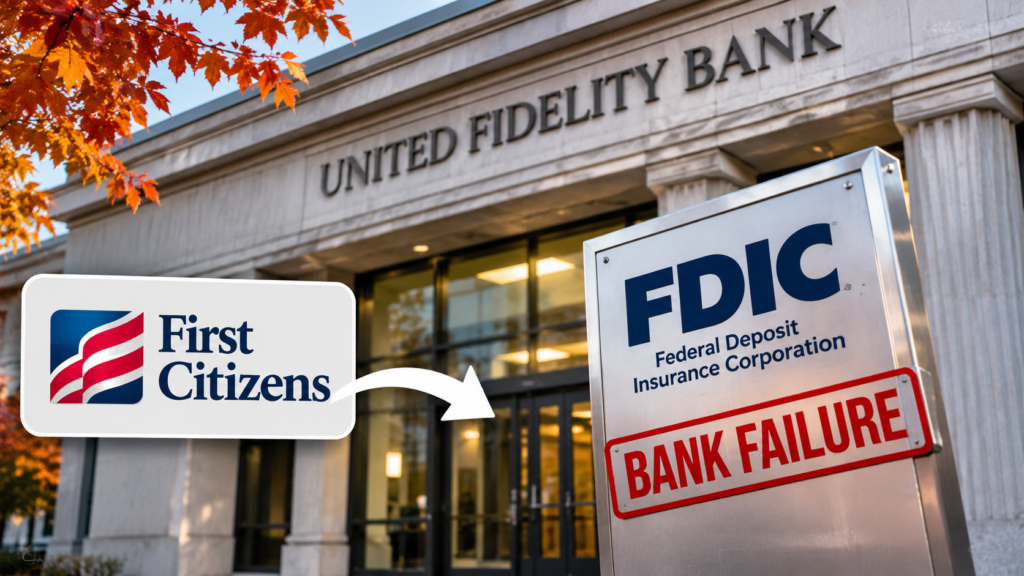
The failure of United Fidelity Bank on Friday, 27 November 2026, will cost the US Deposit Insurance Fund an estimated $1.83 billion, according to the Federal Deposit Insurance Corporation (FDIC). That equals roughly 31% of the Indiana lender’s assets of $5.9 billion. It is the seventh US bank to fail in 2026 and the largest since April 2024.
US regulators shut United Fidelity Bank of Evansville and named the FDIC as receiver. First-Citizens Bank & Trust Company of Raleigh, North Carolina, bought substantially all of its assets and took over almost all of its deposits, so most customers kept access to their money through the weekend.
The deal in one table: what First Citizens takes and what it paid
First Citizens bought United Fidelity Bank out of receivership as a “whole bank purchase”, its parent First Citizens BancShares said in a statement on 27 November. The FDIC picked it through a competitive bidding process.
| Item | United Fidelity Bank figure or detail | Source |
|---|---|---|
| Closing date | Friday, 27 November 2026 | FDIC |
| Closed by | Office of the Comptroller of the Currency (OCC) | FDIC, OCC |
| Total assets (30 September 2026) | About $5.9 billion | FDIC |
| Total deposits (30 September 2026) | About $5.4 billion | FDIC |
| Deposits assumed by First Citizens | $4.5 billion (estimate) | First Citizens |
| Loans bought by First Citizens | $3.1 billion (estimate) | First Citizens |
| Asset discount in the winning bid | About $2.6 billion; no deposit premium | First Citizens |
| Estimated cost to the Deposit Insurance Fund | $1.83 billion | FDIC |
| Branches | 22: 20 across four mainland states, two in the US Virgin Islands | FDIC, First Citizens |
| Holding company | Fidelity Federal Bancorp, outside the receivership | FDIC |
First Citizens said the asset, deposit and loan amounts are estimates based on 30 September balances. They “remain subject to adjustment” once the final closing balance sheet and the settlement with the FDIC are done.
Why the OCC stepped in
The regulator gave its legal grounds but not the business reasons behind the collapse. In its statement on 27 November, the OCC said it appointed the FDIC after concluding that United Fidelity Bank:
“was in an unsafe or unsound condition to transact business and was likely to be unable to pay its obligations or meet its depositors’ demands in the normal course of business.”
Office of the Comptroller of the Currency, 27 November 2026
Neither the OCC nor the FDIC said which loans, funding sources or losses pushed United Fidelity Bank to that point. The FDIC notice adds its standard line that “no advance notice is given to the public when a financial institution is closed”. Until the regulators or the holding company publish more, the cause stays undisclosed.
How United Fidelity Bank compares with 2026’s other failures
The FDIC’s failed bank list shows seven closures in 2026. United Fidelity Bank is the latest of them and, on the regulators’ asset figures, the largest.
| Closing date | Bank | State | Acquirer |
|---|---|---|---|
| 30 January 2026 | Metropolitan Capital Bank & Trust | Illinois | First Independence Bank |
| 1 May 2026 | Community Bank and Trust – West Georgia | Georgia | Anchor Bank |
| 10 July 2026 | Kentland Federal Savings and Loan Association | Indiana | Kentland Bank |
| 17 July 2026 | Small Business Bank | Kansas | The Farmers State Bank of Oakley, Kansas |
| 21 August 2026 | Tioga-Franklin Savings Bank | Pennsylvania | Second Federal Savings and Loan Association of Philadelphia |
| 25 September 2026 | Nano Banc | California | Sunwest Bank |
| 27 November 2026 | United Fidelity Bank, fsb | Indiana | First-Citizens Bank & Trust Company |
The last failure of similar size was Republic First Bank of Philadelphia, closed on 26 April 2024 with Fulton Bank as the buyer, the same FDIC list shows. NPR, citing FDIC figures, put that bank’s assets at $6 billion and its deposits at $4 billion when it failed.
Three numbers behind the sale, worked out
Set side by side, the regulator’s and the buyer’s figures show how much of the loss lands on the insurance fund and how deep the price cut was. These are simple calculations based on the FDIC and First Citizens figures, not numbers either party published.
- Cost to the fund: $1.83 billion is about 31% of the $5.9 billion in United Fidelity Bank assets.
- Asset discount: the roughly $2.6 billion discount in First Citizens’ bid equals about 44% of the $5.9 billion it is taking on.
- Deposit gap: the FDIC put United Fidelity Bank deposits at $5.4 billion, while First Citizens is assuming $4.5 billion, a difference of about $0.9 billion.
First Citizens said it is taking all customer deposits “other than certain brokered deposits and other excluded accounts”. Neither document breaks the $0.9 billion gap down further.
The FDIC calls the fund cost an estimate, and First Citizens says its own figures depend on a post-closing settlement, so both numbers for United Fidelity Bank can still move.

What the failure means for depositors, borrowers and investors
For most customers very little changes in the short term. The FDIC said depositors “do not need to change their banking relationship and will retain all of their funds and deposit insurance coverage”. Its question-and-answer page on United Fidelity Bank sets out the details by type of customer.
| Who | What happens | What to do, per the FDIC |
|---|---|---|
| United Fidelity Bank depositors | Accounts moved to First Citizens; insured separately from any existing First Citizens accounts for at least six months | Keep using existing branches, cards and cheques until First Citizens says systems have changed |
| Holders of fixed-term deposits | Can take money out with no penalty for early withdrawal until they sign a new deposit agreement, unless the deposit secures a loan | Watch for notices on rate changes from First Citizens |
| Brokered deposit holders | Deposits held through Cede & Co. were not transferred | Contact the broker that sold the deposit |
| Borrowers | Loan terms do not change | Keep making payments, including escrow, as usual |
| Unpaid suppliers and creditors | May have a claim against the receivership | File a Proof of Claim with the FDIC as receiver |
| Shareholders of Fidelity Federal Bancorp | The closing did not cover the holding company | Contact the holding company, not the receiver |
The FDIC also lists the order in which allowed claims are paid after administrative expenses. Depositors come first, then general unsecured creditors, then subordinated debt, and stockholders last.
Salaries, social security and other direct deposits continue as usual, the FDIC said. Routing and account numbers stay the same until First Citizens writes to customers, and safe deposit boxes remain open during normal hours.
Branches, weekend access and the Virgin Islands division
United Fidelity Bank ran 22 branches in Indiana, Illinois, Florida, Colorado and the US Virgin Islands. The two island branches traded under the Bank of St. Croix name. First Citizens said all former branches would run as a division of First Citizens Bank from Saturday, 28 November 2026, and all would keep normal hours on Monday, 30 November.
The FDIC said customers could reach their money over the weekend by cheque, ATM or debit card. Its call centre was due to open on Sunday between noon and 4 pm Central Time, and on Monday between 8 am and 5 pm Central Time.
The purchase also takes in United Fidelity Bank’s subsidiaries, among them the real estate developer and manager Pedcor Homes Corporation, according to First Citizens. Accounts will move onto First Citizens’ own systems “at a later date”, the buyer said, without naming one.
What the buyer and the regulators have said
Frank B. Holding, Jr., who chairs First Citizens BancShares and runs it as chief executive, called the purchase a good fit for the group.
“We believe this transaction is both financially and strategically compelling, and we look forward to welcoming our new customers, earning their trust and positioning our company for continued success.”
Frank B. Holding, Jr., First Citizens BancShares, 27 November 2026
First Citizens says its parent holds over $225 billion in assets and sits on the Fortune 500 list. On those figures, the United Fidelity Bank purchase is small next to its balance sheet. The parent trades on Nasdaq as FCNCA.
The FDIC and the OCC limited their public comments to the closure, the buyer and the cost estimate. No statement from Fidelity Federal Bancorp was found on 28 or 29 November.
What is still unclear about United Fidelity Bank
- The cause: neither regulator has said what drove United Fidelity Bank into an “unsafe or unsound condition”.
- The final cost: the $1.83 billion figure is an FDIC estimate, and the $2.6 billion discount can be adjusted after closing.
- The excluded deposits: how much of the $0.9 billion gap is brokered money has not been published.
- Political follow-up: Jim Banks, the Indiana Republican who sits on the Senate Banking Committee, expects a briefing on Monday, 30 November, NPR reported.
- Systems conversion: First Citizens has not dated the move of United Fidelity Bank accounts onto its platforms.
Sources
- FDIC press release on United Fidelity Bank, fsb and First-Citizens Bank & Trust Company (27 November 2026)
- FDIC failed bank information and FAQ: United Fidelity Bank, fsb, Evansville, IN
- FDIC failed bank list
- First Citizens Bank statement on the whole bank purchase (27 November 2026)
- NPR, 28 November 2026 (Republic First figures and Senator Banks briefing)
More world banking and company news: Americas and World Business News.
Based on official documents and statements available up to 29 November 2026. For general information only; not investment advice.
This story follows our editorial policy. Spotted an error? Tell us.