Second FSSAI Prosecution Against Bisleri Sanctioned After Coliform Found in Bengal Water Sample
FSSAI has sanctioned a second prosecution against Bisleri International within a week, after a water sample from its Jalpaiguri plant tested positive for coliform bacteria. Bisleri says two independent labs found the sample compliant and has asked the regulator to review the findings.
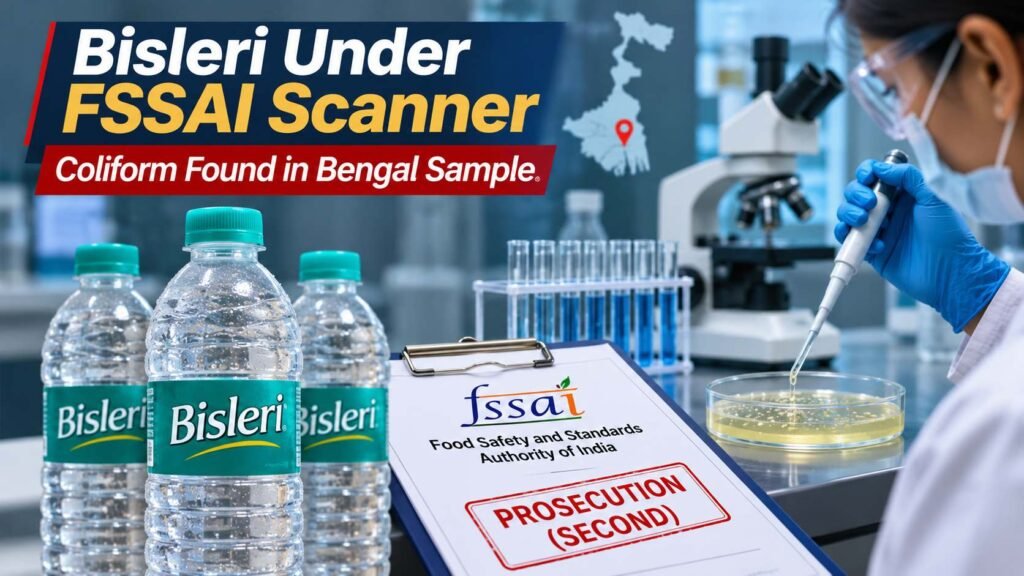
A second FSSAI prosecution against Bisleri International Pvt Ltd has been sanctioned within a week, after a packaged drinking water sample from its plant in West Bengal’s Jalpaiguri district tested positive for coliform bacteria. Sources disclosed the move to PTI, IANS and ThePrint, in reports published on 28 November 2026.
The Food Safety and Standards Authority of India (FSSAI) had announced the first case only days earlier, over a sample from Bisleri’s Goa facility. Bisleri disputes the Bengal result and says two independent laboratories found the same water compliant.
Jalpaiguri Sample Behind the Second FSSAI Prosecution Against Bisleri
The sample came from Bisleri’s plant in Telipara village, Jalpaiguri, and was collected in July 2026, ThePrint reported. It belonged to batch PB 201, manufactured on 20 July 2026 with a use-by date of 19 January 2027.
Both the primary laboratory and the referral laboratory found coliform bacteria in the sample, according to the PTI and IANS reports. FSSAI then prohibited the sale of that single batch on 12 August 2026.
Coliforms are indicator bacteria. They can enter water systems through sewage leaks or damaged pipes, among other routes, PTI reported. ThePrint noted that their presence points to possible contamination or treatment lapses but does not by itself prove that disease-causing organisms are present. No illness linked to the batch has been reported, it added.
The FSSAI prosecution against Bisleri in this case rests on alleged violations of food safety rules, for which the regulator has granted “sanction for prosecution”. PTI said FSSAI’s response could not be obtained immediately. None of the reports names the section of the Food Safety and Standards Act, 2006 invoked, the court, or the penalty sought.
Key Dates in the FSSAI Prosecution Against Bisleri
| Event | Date |
|---|---|
| Goa sample collected | 30 September 2025 |
| Batch PB 201 manufactured at Jalpaiguri | 20 July 2026 |
| FSSAI prohibits sale of batch PB 201 | 12 August 2026 |
| FSSAI announces prosecution in the Goa case | 22 November 2026 (Sunday) |
| Bisleri says its products are safe | 23 November 2026 (Monday) |
| Bengal prosecution sanction reported; Bisleri disputes the findings | 28 November 2026 |
| Use-by date of batch PB 201 | 19 January 2027 |
How the First FSSAI Prosecution Against Bisleri Began in Goa
The Goa sample was collected on 30 September 2025. FSSAI said it did not meet the prescribed bromate limits and declared it unsafe under the Food Safety and Standards Act, 2006.
Bisleri appealed, and the sample went to a referral food laboratory. That laboratory also classified it as unsafe, this time citing polynuclear aromatic hydrocarbons (PAHs). FSSAI then started prosecution proceedings.
Bisleri disputed the Goa findings. According to ThePrint, the company said the matter concerned one batch from 14 months earlier at one of its 143 plants, that an independent FSSAI-approved laboratory found bromate within limits, and that it had not received the prosecution notice.
Bisleri Says Two Labs Found the Bengal Sample Compliant
In a statement on 28 November 2026 responding to the latest FSSAI prosecution against Bisleri, carried by Business Standard from PTI, Bisleri said it had already recalled batch PB201 on FSSAI’s direction. It said it had the sample tested at two independent FSSAI-recognised laboratories, and both found it met the applicable coliform standard.
The company asked FSSAI to examine the sampling process, testing method and laboratory findings, and to identify what caused the different results. It said it expected the matter to be “assessed against the same standards” applied across the industry. ThePrint reported that Bisleri cited a 10-stage process with more than 90 quality tests and said it would keep cooperating with the regulator.
What the Prosecution Means for Water Makers and Buyers
The reports tie the FSSAI prosecution against Bisleri to a wider regulatory drive on packaged water.
- Buyers and retailers: the prohibition covers one batch, PB 201, made on 20 July 2026 at Jalpaiguri. Bisleri says it has recalled that batch. No other batch from the plant is named in the reports.
- Packaged drinking water manufacturers: FSSAI has told State Food Commissioners and its regional directors to step up surveillance, inspection and sampling of packaged drinking water and mineral water, and to act against non-compliant companies.
- Businesses facing a failed sample: in both Bisleri cases, the referral laboratory upheld the first result. Bisleri says separate tests it commissioned at FSSAI-recognised laboratories found its water within limits.
- Food packaging suppliers: FSSAI CEO Rajit Punhani said inspections of packaging materials used for food will begin soon.
Punhani said the enforcement is meant to ensure compliance and not to create panic. FSSAI has stepped up action this year against food business operators, e-commerce companies, and makers of energy drinks and alcoholic beverages, PTI reported.
Nationwide Water Sampling Results Due in One to Two Months
Beyond the FSSAI prosecution against Bisleri, the regulator is collecting packaged drinking water samples across the country, mainly through state food safety authorities working with its offices. Punhani told ANI that laboratory results would take “at least a month or two”, ThePrint reported. He said there was no particular reason for the focus on water, after earlier drives on dairy, meat, eggs, cereals, and energy and sugary drinks.
For more regulator actions, see our FSSAI news section.
This article is for general information only and is not legal, tax or financial advice.
This story follows our editorial policy. Spotted an error? Tell us.