Volkswagen India Tax Case: VW Tells Court BMW, Mercedes and Kia Also Import Car Parts at 10% Duty
Volkswagen's Indian unit says customs wrongly singled it out in a $1.2 billion demand, alleging Mercedes-Benz, BMW and Kia also import parts at 10% duty. The Bombay High Court is due to decide on the challenge on 30 November 2026.
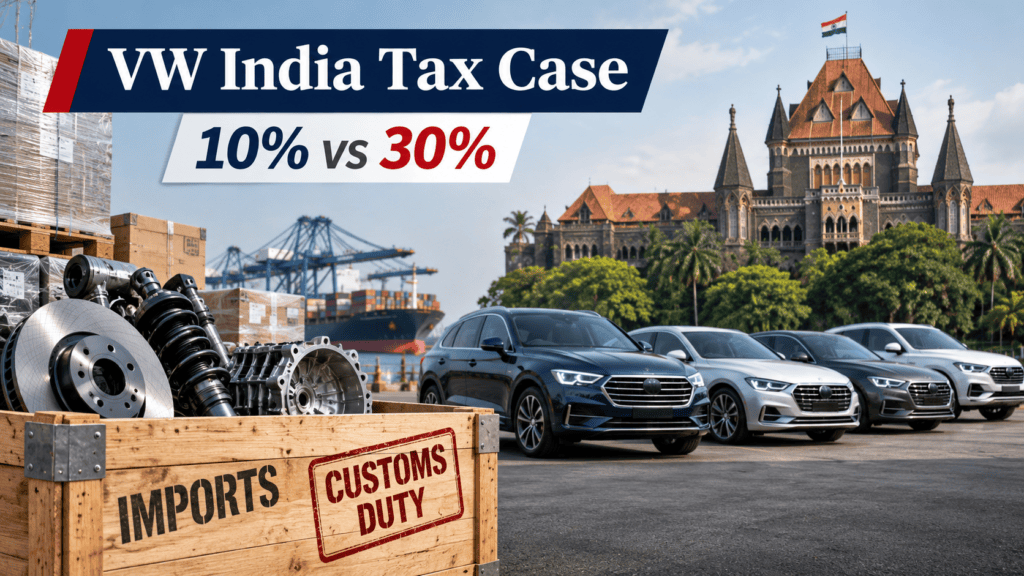
Volkswagen’s Indian unit has told the Bombay High Court that customs authorities wrongly singled it out in a $1.2 billion tax demand, alleging that Mercedes-Benz, BMW and Kia import car parts the same way. Reuters reported the filing on 27 November 2026.
The Volkswagen India tax case turns on one question: should the company have paid about 30% duty on car kits, instead of the 10% it paid on components? The court is due to decide on the challenge on Monday, 30 November 2026.
Volkswagen India Tax Case: What the 10 November Filing Says
Skoda Auto Volkswagen India filed the submission on 10 November 2026. It is not public. Reuters reviewed the filing and reported its contents for the first time.
According to Reuters, the company argued that every maker of comparable cars follows the same model of importing parts and components and pays 10% duty. It said the demand should be quashed because it requires Volkswagen alone to pay 30% while others pay 10%.
A one-page table in the filing listed import shipment numbers for Mercedes-Benz, BMW, Kia, Isuzu Motors and JSW MG Motor, the Indian unit of SAIC. The filing said BMW had 390,360 major import shipments of components in 2024 and Mercedes-Benz had 80,972, all under the lower tariff category. Reuters did not report figures for the other three companies.
These are Volkswagen’s allegations in a court filing. No court has examined or accepted them.
What Customs Alleges
Customs alleges in the Volkswagen India tax case that the company deliberately imported components at a 10% tariff and then assembled them into complete cars in India, avoiding the higher rate of about 30% on car kits. According to Reuters, authorities say the company shipped nearly complete Audi, Skoda and Volkswagen cars as individual parts in separate consignments and used internal software to manage these imports.
In an October 2026 submission, the authorities described Volkswagen’s conduct as one of “fraud and subterfuge”. They told the court that other carmakers were paying the rightful duty on parts imports. Volkswagen denies the allegations.
The 10% and 30% Duty Gap
As reported by LiveLaw in February 2025, a 2011 notification taxes completely knocked down (CKD) units at 30% and individual parts at 10%. A CKD unit is a car shipped in pieces for assembly in the importing country. Volkswagen argues that it imports only parts, not whole cars, so the CKD rate should not apply.
Reuters’ latest report puts the demand in the Volkswagen India tax case at $1.2 billion. Earlier reports, including LiveLaw’s, described it as $1.4 billion. The reports do not explain the difference. For other recent customs changes, see DBN’s report on Notification 37/2026-Customs and the customs news section.
Skoda Auto Volkswagen India declined to comment, citing the ongoing proceedings. Kia did not comment on the filing but said it imports car components in line with applicable laws. The other named carmakers and India’s tax authorities did not respond to Reuters.
Key Dates in the Volkswagen India Tax Case
| Event | Date |
|---|---|
| Customs authorities’ submission alleging “fraud and subterfuge” | October 2026 |
| Skoda Auto Volkswagen India’s submission naming rival carmakers | 10 November 2026 |
| Reuters reports the filing | 27 November 2026 |
| Court due to decide on Volkswagen’s challenge | 30 November 2026 |
How the Volkswagen India Tax Case Reached This Point
- 2024: Customs raised the demand through a show cause notice.
- 2025: The company challenged it in the Bombay High Court in Skoda Auto Volkswagen India Pvt. Ltd. vs. Union of India and Ors. (WP/2051/2025).
- February 2025: A bench of Justices B P Colabawalla and Firdosh Pooniwalla said orally that it was prima facie not satisfied with Volkswagen’s argument. This was an oral remark, not a finding.
- April 2025: The bench reserved judgment, according to Outlook Business.
- 25 August 2026: The same bench released the case without a verdict, saying pressure of work had prevented it from pronouncing judgment. It ordered status quo for four weeks and sent the matter to the regular bench for indirect tax petitions, as Bar & Bench and Outlook Business reported.

What the Filing Means for Carmakers and Importers
- Rival carmakers: Reuters reported that if Volkswagen succeeds with its argument about how rivals import parts, other carmakers could face closer scrutiny in the world’s third-largest car market.
- The burden on Volkswagen: One source told Reuters that, to succeed, Volkswagen must show that its rivals’ imports were used to assemble complete vehicles.
- Customs’ position: The authorities maintain that other carmakers pay the correct duty. Kia says its imports follow applicable laws.
- The classification question: The Volkswagen India tax case concerns whether parts shipped separately should be taxed as individual components at 10% or as kits at about 30%.
- Stakes for Volkswagen: The company, which has about 2% of the Indian market, has called the case a matter of life and death that could wipe out its investments in India.
Bombay High Court Due to Rule on Monday
Reuters reported that the court will decide on Volkswagen’s challenge on Monday, 30 November 2026. Sources told Reuters the court is likely, for now, to rule only on whether tax authorities could go back 12 years in examining Volkswagen’s imports.
Sources
- Reuters (via SRN News): Volkswagen drags rivals Mercedes, BMW into $1.2 billion India tax fight, 27 November 2026
- LiveLaw: Bombay High Court hearing in Skoda Auto Volkswagen India vs. Union of India, February 2025
- Outlook Business: HC bench releases Skoda Volkswagen tax case without verdict
- Bar & Bench: Bombay HC bench releases Volkswagen tax case, 25 August 2026
This article is for general information only and is not legal, tax or financial advice.
This story follows our editorial policy. Spotted an error? Tell us.