Americans Spend $13.1 Billion Online on Black Friday, Up 11%, While Store Visits Fall Across Three Trackers
Americans spent $13.1 billion online on Black Friday 2026, up 11%, Adobe Analytics says, while three trackers show fewer store visits. DBN puts the Adobe, Mastercard, Salesforce and foot-traffic data side by side.
$13.1 billion: that is how much Americans spent online on Black Friday, 27 November 2026, according to Adobe Analytics, up 11% from a year earlier and above the company’s own forecast of about $12.9 billion. Other early Black Friday spending data released on Saturday, 28 November, tell a more mixed story: store visits fell, order volumes rose more slowly than sales, and inflation explains part of the growth.
Black Friday spending is the first hard read on the US holiday season. Because each data provider measures something different, the clearest picture comes from putting their numbers side by side.
Black Friday spending: what each data source measured
The preliminary figures below come from the companies that publish them. None is an official government statistic, and they cover different things, so they should not be added together.
| Source | What it measures | Black Friday 2026 result |
|---|---|---|
| Adobe Analytics | US online spending, based on over a trillion visits to American retail websites | $13.1 billion, up 11% year on year |
| Mastercard SpendingPulse | US retail sales in stores and online, all payment types, excluding cars and petrol | Up 5.8% year on year; in-store up 3.8% |
| Salesforce | Online shopping data covering about 1.5 billion consumers worldwide | Global $82.7 billion, up 5%; US $19.1 billion; order volume up 5% |
| PassBy | US store foot traffic (geospatial data) | Nearly 930 million visits, down 2.2% |
| RetailNext | Store customer counts | Down 2.9% on 2025 |
| Sensormatic Solutions | Store foot traffic | Down 4.2% on the previous Black Friday; up 250% on the Friday a week earlier |
Adobe’s and Salesforce’s US online totals differ, $13.1 billion against $19.1 billion, because the two firms draw on different data sets and methods. Neither figure is wrong; they answer different questions about Black Friday spending.
Online up, stores down
The clearest pattern in the data is the split between web and store. Adobe’s online total grew 11%, while all three foot-traffic trackers reported fewer store visits than on Black Friday 2025.
Stores still matter. Physical shops account for most Black Friday sales, and Mastercard SpendingPulse said in-store spending rose 3.8%, the fastest since 2022. No source has published an average spend per store visit.
Joe Shasteen, global manager of advanced analytics at RetailNext, said pressure on essentials such as fuel, groceries and rent “changes how they plan every shopping trip”. Poor weather in many parts of the US may also have kept some shoppers at home.
How much of the growth is inflation?
Part of the rise in Black Friday spending reflects higher prices rather than more goods. The personal consumption expenditures price index rose 3.8% in the year to October, CNBC reported, and October consumer prices climbed 0.4% from September after seasonal adjustment, a bigger rise than forecast. Two of the data providers gave clues to the split between price and volume:
- Salesforce: the number of Black Friday orders rose 5% year on year, so sales growth was not driven by prices alone.
- Mastercard Economics Institute: chief economist Michelle Meyer said it expects inflation to account for half of the forecast rise in holiday sales this year.
As a rough guide, using the figures above, Adobe’s 11% online growth is well ahead of 3.8% inflation, while Mastercard’s 5.8% total retail growth is about two percentage points above it. The comparison mixes different measures and is indicative only.
The backdrop: squeezed, but still spending
Surveys taken before the day pointed to cautious but willing shoppers, which framed expectations for Black Friday spending:
- The Conference Board: planned holiday spending averages $1,049 per person, 5.9% more than last year’s $990, or 3.2% more after inflation.
- Deloitte: 87% of shoppers said they intended to shop the Black Friday and Cyber Monday deals, up from 82% in 2025 and the highest since 2016. Some 40% of Gen Z shoppers planned to use buy now, pay later.
- Adobe: Americans spent $82.5 billion online in the first 22 days of November, up 9.1%.
- Salesforce: for the week of 24–30 November it predicted record online sales, $84 billion in the US and $357 billion worldwide, each 6% higher.
“It’s sort of the mix of feeling the squeeze on prices, people thinking about their economic condition and their financial position, but still wanting to protect the holidays.”
Brian McCarthy, retail strategy lead, Deloitte
What shoppers bought
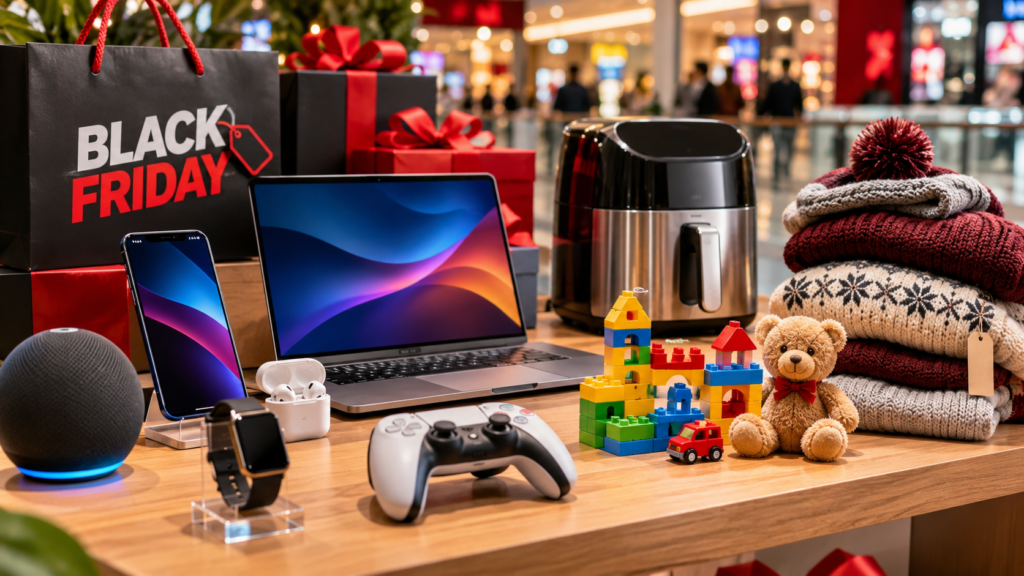
Technology led Black Friday spending. Mastercard SpendingPulse said spending on electronics and software was almost 8% higher than in 2025. Adobe listed gaming consoles, video games, phones, headphones and smart glasses among the best sellers.
Everyday items sold well too. According to Adobe, shoppers took advantage of deals to buy clothes, baby goods, pet products and cleaning supplies. Price cuts on clothing and household appliances also helped push online Black Friday spending past Adobe’s forecast.
AI shopping tools and buy now, pay later
Two trends in the Adobe data stand out for retailers planning the rest of the season:
- AI-assisted shopping: visits that came via chatbots and AI-powered browsers were 68% more likely to end in a purchase than a year ago, Adobe said.
- Buy now, pay later: Adobe expects these services to carry $1.09 billion of Cyber Monday online sales, 5.3% more than last year.
Adobe did not say what share of total Black Friday spending came through AI tools, only how well that traffic converted into sales.
What it means for retailers and the holiday season
The Black Friday spending numbers give retailers, brands and investors an early read, but only an early one. Based on the published forecasts:
| Period | Forecast or result | Source |
|---|---|---|
| Black Friday (27 November) | $13.1 billion online, up 11% | Adobe Analytics |
| Cyber Monday (30 November) | $15.1 billion online expected, up 6.2% | Adobe Analytics forecast |
| Thanksgiving to Cyber Monday (five days) | About $47.5 billion online expected | Adobe Analytics forecast |
| November–December holiday season | $1.01 trillion, up 4.2% (3.1% growth a year earlier) | National Retail Federation forecast |
In short, the online figures from Adobe and Salesforce rose, the three store-traffic trackers all reported fewer visits, and Mastercard expects inflation to account for half of holiday sales growth. Retailers selling mainly online and chains relying on store visits are therefore reading different signals from the same day.
Retail executives had sounded hopeful in the run-up. Walmart’s finance chief, John David Rainey, said the holiday quarter was “off to a pretty good start”, while Target chief executive Michael Fiddelke said the company was “encouraged by the start of the quarter”.

What to watch next
- Cyber Monday results on 30 November against Adobe’s $15.1 billion forecast.
- Whether Black Friday spending growth holds once full-season data are published.
- Official US retail sales figures for November from the Census Bureau, which will show whether private data match the government count.
- Store-traffic trends after Black Friday spending peaks, through December, as RetailNext, Sensormatic and PassBy update their counts.
Sources
- Reuters (via Union Leader), 28 November 2026: Adobe Analytics figures and PassBy traffic
- CNBC, 27 November 2026: inflation data, surveys and retailer comments
- Fox Business, 28 November 2026: Adobe data and NRF holiday forecast
More from the region: Americas and World Business News.
Based on company data and statements available up to 29 November 2026. Figures are preliminary. For general information only; not investment advice.
This story follows our editorial policy. Spotted an error? Tell us.