GSTN Sets 1 January 2027 for E-Invoicing RCM Self Invoice and Import of Services Reporting
GSTN Advisory No. 688 confirms that e-invoicing for RCM self-invoices on purchases from unregistered persons (RCMDOM) and on import of services (RCMIMP) becomes mandatory from 1 January 2027. Voluntary IRN generation runs from 15 to 31 December 2026.
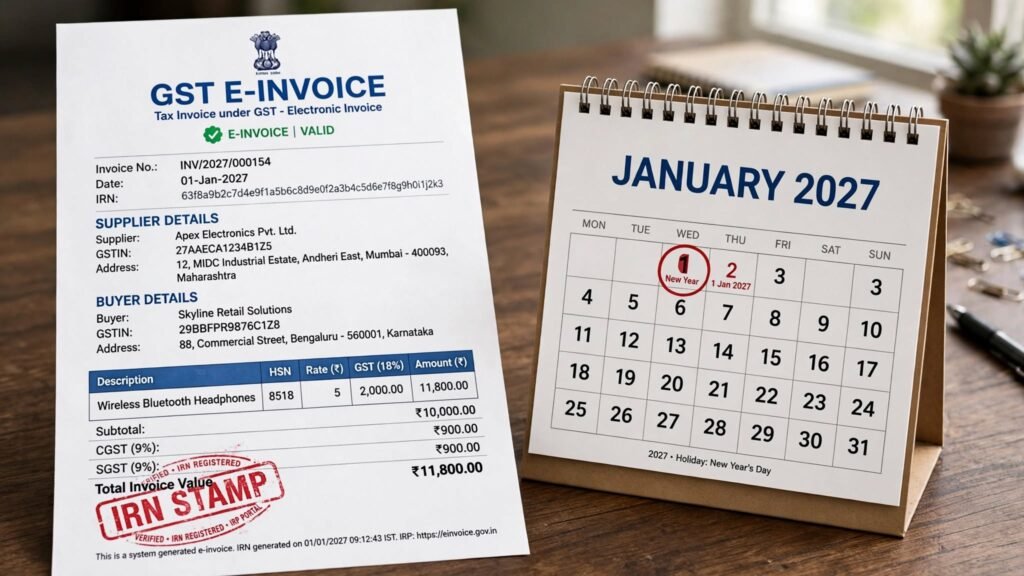
The e-invoicing RCM self invoice requirement takes effect on 1 January 2027, the Goods and Services Tax Network (GSTN) has confirmed in Advisory No. 688 dated 17 November 2026. Businesses covered by GST e-invoicing must then obtain an Invoice Reference Number (IRN) for self-invoices on reverse charge purchases from unregistered persons and on import of services. A voluntary production window opens on 15 December 2026.
Key Highlights
- GSTN Advisory No. 688, dated 17 November 2026, sets 1 January 2027 as the mandatory date for e-invoicing of two new supply types: RCMDOM and RCMIMP.
- The legal basis is Notification No. 04/2026-Central Tax dated 26 October 2026. Rule and schema changes are in Notification No. 05/2026-Central Tax of the same date.
- The functionality is already live in the sandbox of all six authorised Invoice Registration Portals (IRPs).
- From 15 to 31 December 2026, eligible taxpayers may generate IRNs voluntarily in production for documents dated 15 December 2026 or later.
- The advisory does not restate who is covered by the e-invoicing RCM self invoice rule. It points to the notifications for applicability and scope.
What GSTN Advisory 688 Says
Advisory No. 688 continues GSTN’s earlier advisory of 16 October 2026 (Advisory No. 678). That advisory introduced e-invoicing for recipient-generated self-invoices under the Reverse Charge Mechanism (RCM) and enabled two new supply type codes in the sandbox. It did not give a production date.
The new advisory fills that gap for the e-invoicing RCM self invoice framework. It records that the Government has extended e-invoicing to both categories from 1 January 2027 through Notification No. 04/2026-Central Tax. It then sets out sandbox availability, a production window, a document-date condition and readiness steps for taxpayers and technology partners.
RCMDOM and RCMIMP Explained
Under the reverse charge mechanism, the buyer pays the GST instead of the seller. Where the seller is unregistered or outside India, the buyer also prepares the invoice itself. This document is called a self-invoice.
RCMDOM: Domestic Supplies from Unregistered Persons
RCMDOM covers self-invoices for specified domestic supplies received from unregistered persons, where the registered recipient pays tax under reverse charge. As A2Z Taxcorp notes, this self-invoice is required under Section 31(3)(f) of the Central Goods and Services Tax Act, 2017.
RCMIMP: Import of Services
RCMIMP covers self-invoices for services imported from suppliers outside India, where the registered recipient pays tax under reverse charge. A typical case is a business paying a foreign vendor for software subscriptions or professional services.
Under the e-invoicing RCM self invoice process, the recipient will select the RCMDOM or RCMIMP code when reporting the self-invoice to an authorised IRP. After validation, the IRP issues an IRN, the unique reference number that marks a document as a registered e-invoice.
E-Invoicing RCM Self Invoice Timeline
The advisory sets out a phased rollout. Testing stays in the sandbox, while production use opens about two weeks before the mandatory date.
| Stage | Date | What applies |
|---|---|---|
| Sandbox testing | Available now (announced 16 October 2026) | Live on all six authorised IRPs; to be used for testing with sample data |
| Production enablement | Proposed from 15 December 2026 | Production system to accept RCMDOM and RCMIMP IRN requests |
| Voluntary window | 15 to 31 December 2026 | Eligible taxpayers may generate IRNs for genuine transactions; only documents dated 15 December 2026 or later are accepted |
| Mandatory | 1 January 2027 | E-invoicing for RCMDOM and RCMIMP becomes compulsory under the notified provisions |
The advisory separates the two environments. The sandbox is for testing with sample data. The production environment is for genuine transactions only, so test entries for e-invoicing RCM self invoice documents should not be pushed to live IRPs during the voluntary window.
Notifications 04 and 05/2026-Central Tax: The Legal Basis
Notification No. 04/2026-Central Tax, issued on 26 October 2026 as G.S.R. 918(E), amends Notification No. 13/2020-Central Tax dated 21 March 2020. That earlier notification was issued under rule 48(4) of the CGST Rules, 2017, which governs which invoices must be reported through the IRP.
The amendment replaces the description of covered transactions with a four-item list:
- Supplies of goods or services to a registered person.
- Supplies of goods or services for exports.
- Supplies received from an unregistered person, where the recipient pays tax under reverse charge.
- Import of services.
The change, which brings the e-invoicing RCM self invoice requirement into force, takes effect from 1 January 2027. Import of goods does not appear in the list. Notification No. 05/2026-Central Tax, of the same date, amends the CGST Rules and the e-invoice schema. According to A2Z Taxcorp, it updates FORM GST INV-01 to Version 1.2 and adds the two new supply type codes.
Who Is Covered by the E-Invoicing RCM Self Invoice Rule
Advisory 688 refers only to “eligible taxpayers” and does not restate a turnover limit. Notification 04/2026-Central Tax amends the description of covered transactions in Notification 13/2020. It does not itself contain threshold wording.
As reported by Taxscan, the threshold for generating e-invoices is aggregate annual turnover (AATO) of Rs. 5 crore and above. On that reading, the e-invoicing RCM self invoice obligation applies to businesses already within the e-invoicing net. Businesses near the limit should confirm their position against the notifications before 1 January 2027.
Readiness Checklist for ERP, ASP and GSP Setups
The advisory asks taxpayers, GST Suvidha Providers (GSPs), Application Service Providers (ASPs), ERP providers and other integration partners to finish their work well before the mandatory date. Its readiness steps are:
- Develop and test in the sandbox: complete development, integration and testing on the sandbox, using sample data only.
- Use the technical specifications: detailed specifications, business validations and validation codes are on the NIC e-Invoice API Developer Portal.
- Follow NIC IRP-1 release notes: stakeholders should track the relevant release notes and technical documentation.
- Brief the wider ecosystem: inform connected partners about the new reporting requirement.
- Watch for updates: further updates are to be posted on the e-invoice portal.
In practice, the first internal task is to identify which purchases would fall under the two codes. For e-invoicing RCM self invoice compliance, this means purchases from unregistered persons that attract reverse charge and payments for services from overseas suppliers.
What Is Still to Be Confirmed
Two points need watching before the e-invoicing RCM self invoice rollout. First, the advisory leaves applicability and scope to the notifications, so the turnover threshold should be checked against the notified text rather than the advisory. Second, field-level requirements for the new supply types sit in the NIC developer documentation and IRP-1 release notes, which may be updated before the rollout.
GSTN has described production enablement from 15 December 2026 as proposed. Any change to that date would be announced through a further advisory. For more updates, follow our GST news and Taxation sections.
Frequently Asked Questions
When does e-invoicing RCM self invoice reporting become mandatory?
It becomes mandatory from 1 January 2027 under Notification No. 04/2026-Central Tax dated 26 October 2026. GSTN Advisory No. 688 confirms this date and allows voluntary IRN generation in production from 15 to 31 December 2026 for documents dated 15 December 2026 or later.
What are RCMDOM and RCMIMP?
They are two new e-invoice supply type codes. RCMDOM is for self-invoices on domestic supplies received from unregistered persons where the recipient pays tax under reverse charge. RCMIMP is for self-invoices on import of services from suppliers outside India, where the recipient pays tax under reverse charge.
Does the change cover import of goods?
No. The list inserted by Notification No. 04/2026-Central Tax covers supplies to registered persons, exports, supplies received from unregistered persons under reverse charge, and import of services. Import of goods is not in that list.
Can businesses test the new codes before 1 January 2027?
Yes. The RCMDOM and RCMIMP functionality is live in the sandbox of all six authorised IRPs. GSTN says testing should use sample data in the sandbox only, while the production environment is reserved for genuine transactions.
Sources
- GST Portal: Advisory No. 688 on e-Invoicing for RCMDOM and RCMIMP (17 November 2026)
- Notification No. 04/2026-Central Tax dated 26 October 2026 (Gazette copy)
- Taxscan: GSTN issues new advisory on implementation of e-invoicing for RCMDOM and RCMIMP
- A2Z Taxcorp: GSTN’s advisory on e-invoicing for RCMDOM and RCMIMP
This article is for general information only and is not legal, tax or financial advice.
This story follows our editorial policy. Spotted an error? Tell us.