Draft GST Return Rules: GSTR-3B Must Match GSTR-1 and GSTR-2B From April 2027, Comments Till 30 November
Key Highlights
- The Central Board of Indirect Taxes and Customs (CBIC) has opened public consultation on draft rules for the GST return changes 2027, with comments accepted on MyGov from 1 November to 30 November 2026.
- The GST Council recommended the mechanism at its 57th meeting on 8 October 2026. The GST return changes 2027 are proposed to apply from the April 2027 return period.
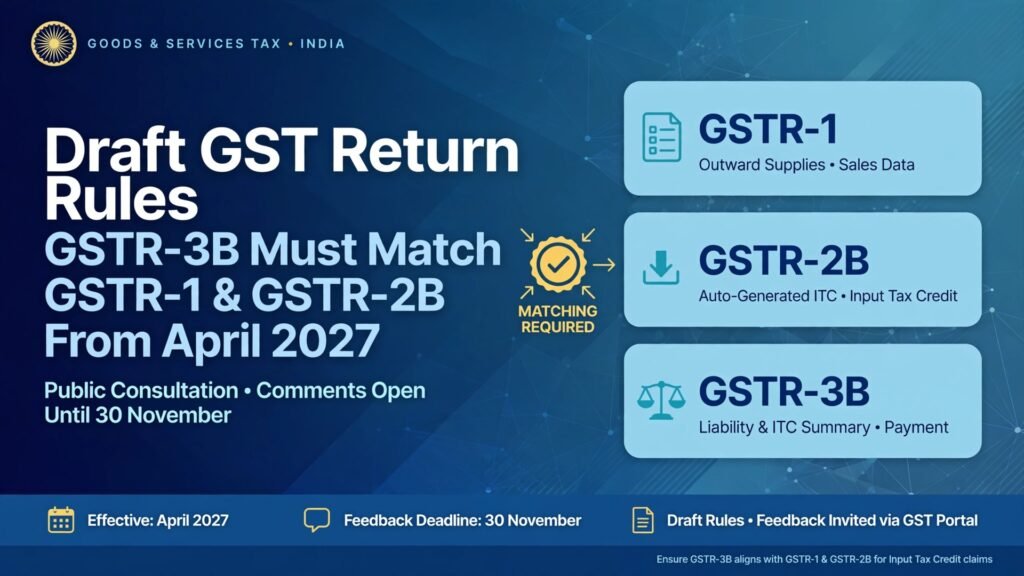
- Tax liability in GSTR-3B would have to match GSTR-1, GSTR-1A or the Invoice Furnishing Facility (IFF) under a new rule 61(1A).
- Input tax credit (ITC), other than reverse charge ITC, would have to match GSTR-2B under a new rule 61(1B).
- The Invoice Management System (IMS) would be written into the CGST Rules, 2017 through a new rule 60(6A).
- Monthly filers could keep a credit note pending in IMS until the GSTR-3B of the second succeeding month, and quarterly filers until the next quarter’s GSTR-3B.
- Separately, e-invoicing of reverse charge self-invoices and import-of-services invoices becomes mandatory from 1 January 2027 for taxpayers covered by e-invoicing.
What Was Released and the Timeline
CBIC, under the Ministry of Finance, has invited comments until 30 November 2026 on the GST return changes 2027, a set of draft rules under which errors in tax liability and ITC would be corrected in the source statements instead of by editing GSTR-3B. The consultation opened on 1 November 2026 on the MyGov Innovate India portal.
The consultation note is titled “Alternate mechanism for making amendment of liabilities and input tax credit in returns in FORM GSTR-3B”. It runs to 93 pages and has three parts:
- Annexure A: draft amendments to the CGST Rules, 2017
- Annexure B: redlined changes to nine forms: GSTR-1, GSTR-1A, GSTR-2B, GSTR-3B, PMT-02A, PMT-02B, PMT-04, PMT-10 and DRC-03
- Annexure C: a draft circular on reporting ITC and its reversal in GSTR-3B
The GST Council approved the proposal at its 57th meeting, held in New Delhi on 8 October 2026 under the chairpersonship of Union Finance Minister Nirmala Sitharaman. According to the Council’s press release, the provisions are to come into force “from the return of April, 2027” after a time-bound public consultation. The Council authorised the Union Finance Minister to approve changes based on stakeholder feedback.
For a monthly filer, the April 2027 GSTR-3B is due by 20 May 2027. The existing GSTR-3B process continues for return periods up to March 2027. The proposals take legal effect only when the amended rules and forms are notified.
According to the consultation note, editing auto-populated figures in GSTR-3B creates mismatches between liability in GSTR-1 and tax paid in GSTR-3B, and between ITC in GSTR-2B and ITC availed in GSTR-3B. The note says these differences frequently result in demand notices and automated intimations.
Gaurav Singh, Commissioner (GST Policy Wing), CBIC, announced the consultation on 22 October 2026. As reported by The Hindu, he described return mismatches as a major pain point and said IMS was being improved so that GSTR-3B would not need editing.
How GST Returns Rules Work Today
- GSTR-1: statement of outward supplies, filed monthly or quarterly. Quarterly filers can report B2B invoices for the first two months of a quarter through IFF.
- GSTR-1A: optional statement, filed once per tax period, to add or amend the current period’s GSTR-1 details before GSTR-3B is filed. It cannot currently be used for earlier tax periods or to correct a recipient’s GSTIN.
- GSTR-2B: auto-drafted ITC statement generated on the 14th of the following month, based on suppliers’ filings and the recipient’s actions in IMS.
- GSTR-3B: summary return through which tax is paid. Liability is auto-filled from GSTR-1, GSTR-1A or IFF, and ITC from GSTR-2B.
Under a GSTN advisory dated 7 June 2025, auto-populated tax liability in GSTR-3B has been non-editable since the July 2025 tax period, with corrections routed through GSTR-1A. Auto-filled ITC can still be edited.
IMS has operated on the GST portal since October 2024. The credit reversal and reclaim statement has been available since the August 2023 return period. The RCM liability/ITC statement has been available since August 2024 for monthly filers and the July to September 2024 quarter for quarterly filers.
Of these facilities, only GSTR-1A is currently provided for in the CGST Rules. The GST return changes 2027 would give the others a basis in the Rules.
What the GST Return Changes 2027 Propose
Liability Corrections at Source
- New rule 61(1A): outward supplies declared in GSTR-3B must not vary from GSTR-1 as amended through GSTR-1A, or from IFF.
- Earlier-period errors: to be corrected in the outward supply statement of the period in which they are noticed, within the time limit under section 37(3) of the CGST Act. Reverse charge liability can be adjusted in a later return.
- GSTR-1A: would allow amendments for earlier tax periods, within the section 37(3) limit, and correction of the recipient’s GSTIN.
- GSTR-1 tables: Table 4 (B2B supplies) would be split into separate tables, including one for supplies made through e-commerce operators that collect tax at source under section 52.
IMS Becomes the Route for ITC
- New rule 61(1B): ITC other than reverse charge ITC must not be at variance with the ITC made available in GSTR-2B.
- New rule 60(6A): a recipient may accept, reject or keep pending each document in IMS. Documents with no action by the time GSTR-3B is filed would be deemed accepted. Bills of entry cannot be rejected.
- Pending period: invoices and debit notes may be kept pending until the time limit under section 16(4) or 16(6) expires.
Reversal, Reclaim and RCM Statements
- FORM GST PMT-02A (new rule 86C): Electronic Credit Reversal and Reclaim Statement. Reclaimed ITC, reported in a new Table 4(AA) of GSTR-3B, cannot exceed the statement balance.
- FORM GST PMT-02B (new rule 86D): Electronic Statement of tax paid on reverse charge and ITC claimed. RCM ITC cannot exceed the RCM liability declared plus the statement balance.
- FORM GST PMT-10 (new): self-assessed rectification of excess permanent reversals reported in Table 4(B)(1) of an earlier period, subject to the time limit under section 39(9).
- FORM GST PMT-04 (amended): to report discrepancies in the two statements.
Other Proposed Changes
- DRC-03 Part B: where tax is paid after an audit, inspection, scrutiny or enforcement action, the taxpayer may declare the related invoice or debit note within seven days of payment. The details would flow into GSTR-1 without the tax being auto-populated again in GSTR-3B.
- Rules 88C and 88D: the rules under which mismatch intimations are issued in DRC-01B (liability) and DRC-01C (ITC) would be omitted from a prospective date.
Credit Notes: Longer IMS Window and Invoice Linking
Since the October 2025 tax period, a recipient can keep a credit note pending in IMS for one tax period, which is one month for monthly filers and one quarter for quarterly filers. This was introduced through a GSTN advisory dated 23 September 2025.
Under the GST return changes 2027, the window would be longer:
- Monthly filers: until GSTR-3B is filed for the second succeeding month
- Quarterly filers: until GSTR-3B is filed for the next quarter
- Outer limit: the end of the month in which that GSTR-3B is due, after which the credit note is deemed accepted
For example, a credit note in a monthly filer’s April 2027 IMS could be kept pending until the June 2027 GSTR-3B is filed, but not beyond 31 July 2027.
Interest under section 50 would apply where ITC linked to a pending credit note had been availed and utilised. Under a new rule 67B, if a recipient rejects a credit note in IMS, the supplier must pay the attributable tax in its next return, with interest from the due date of the return in which the credit note was declared.
Suppliers may link credit and debit notes to the original invoices in GSTR-1, GSTR-1A or IFF. The consultation note states that this linking is on “a purely voluntary basis”. A new column in Table 9 of GSTR-1 would also record the type of underlying supply for each credit or debit note.
What the GST Return Changes 2027 Mean for Small Businesses
- Who is covered: regular taxpayers filing GSTR-3B, both monthly and quarterly. Quarterly filers get a quarterly window for GSTR-1A and for keeping credit notes pending.
- Form layouts: the redlined forms change tables in GSTR-1, GSTR-1A, GSTR-2B and GSTR-3B, including the new Table 4(AA) in GSTR-3B and a new table in GSTR-2B listing rejected documents.
- Rejections in IMS: the draft circular states that a rejection increases the supplier’s liability. It says recipients should reject only documents that do not belong to them or contain discrepancies, and may keep documents pending where the conditions of section 16(2), such as receipt of the goods or services, are not yet met.
- Consultation: taxpayers, tax practitioners, industry associations and other stakeholders can comment on MyGov until 30 November 2026. Suggestions may cover more than one area but cannot be edited after submission. The consultation terms state that acceptance of a suggestion is not guaranteed.
E-Invoicing of RCM Self-Invoices From 1 January 2027
This change is separate from the GST return changes 2027 and takes effect earlier.
- Notification No. 04/2026-Central Tax, dated 26 October 2026: brings two documents under e-invoicing from 1 January 2027. These are self-invoices for supplies received from unregistered persons on which the recipient pays tax under reverse charge, and invoices for import of services.
- Who is covered: taxpayers already under e-invoicing. The aggregate turnover threshold remains Rs 5 crore.
- Notification No. 05/2026-Central Tax, of the same date: revises the e-invoice schema (FORM GST INV-01) to version 1.2, with two new supply types, RCMDOM (domestic reverse charge) and RCMIMP (import of services).
- GSTN Advisory No. 678, dated 16 October 2026: enabled both supply types in the sandbox of all six Invoice Registration Portals (IRPs).
- GSTN Advisory No. 688, dated 17 November 2026: states that the facility is proposed for IRP production environments from 15 December 2026. Eligible taxpayers may generate IRNs voluntarily from 15 to 31 December 2026, and reporting becomes mandatory only from 1 January 2027. Production will accept documents dated 15 December 2026 or later.
Disclaimer
This article is based on information available from public sources and official statements as on 17 November 2026. It is published for general information only and does not constitute financial, investment or legal advice. DailyBusinessNews does not guarantee the completeness of this information and is not responsible for any decision taken on its basis. Readers should verify the details with official sources.
This story follows our editorial policy. Spotted an error? Tell us.