Chinese Chip Stocks Post Record Gain After State Council Pledges ‘National Team’ Support for Markets
Chinese chip stocks posted their biggest one-day gain on record on 27 November 2026 after a State Council meeting pledged stronger market support and named the state-backed 'national team'. The CSI 300 rose about 4%.
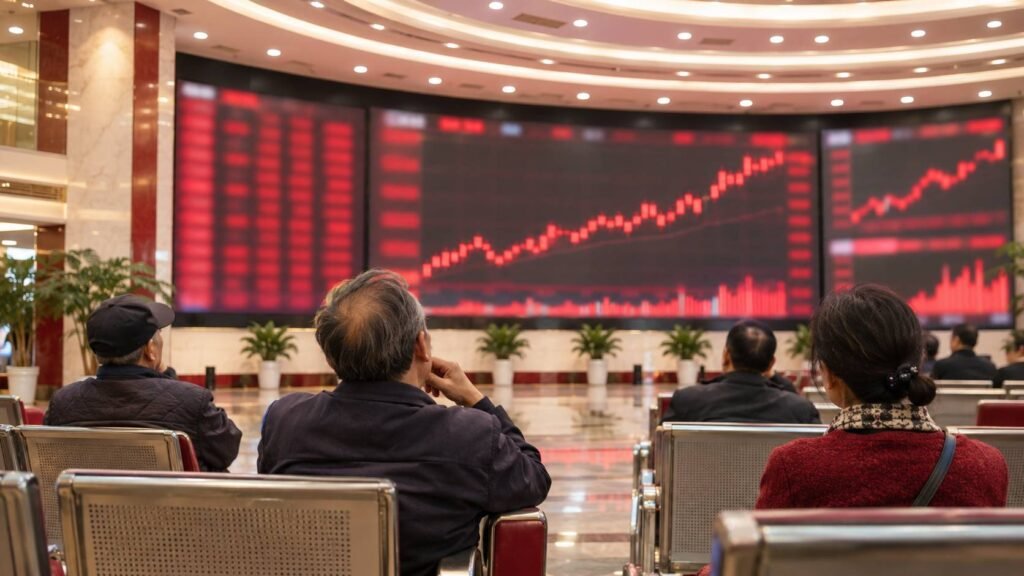
17.6%: that was the one-day gain in China’s CSI Semiconductor index on Friday, 27 November 2026, the largest on record, as a China stocks rally followed an unusual midday readout from the State Council promising stronger support for the market. The benchmark CSI 300 rose about 4%, its biggest daily gain since October 2024, a day after hitting its lowest level since spring 2025.
The readout of a State Council executive meeting chaired by Premier Li Qiang called the capital market “vital to overall economic development”. For the first time in such a readout, it gave state-backed funds, known as the “national team”, an explicit role in steadying share prices.
What the State Council readout says
The official English readout, published by Xinhua and carried on the central government’s website on 27 November, lists the measures behind the China stocks rally. It is a statement of intent rather than a new rulebook; follow-up rules have not yet been issued.
| Commitment in the readout | What it covers |
|---|---|
| Counter-cyclical adjustment | Strengthen it while pushing ahead with key reforms |
| Market-stabilising mechanisms | Improve them, use existing policies fully, and consider new measures |
| Listed companies | Encourage higher dividends and more share buybacks |
| State-backed funds | Give them a greater role in steadying the market |
| Central Huijin Investment | Optimise its quasi-“stabilization fund” function to provide sufficient liquidity |
| Long-term money | Better policies to steer money from insurers, company pension plans and the social security fund into shares |
| Supervision | Act against financial fraud and non-compliant share sales; protect investors |
| External shocks | Build up defences against risks that arrive from abroad |
The readout also called for faster development of a multi-tiered capital market. China’s securities regulator later said it would work with other authorities to speed up policies to stabilise the market, and its chairman, Wu Qing, held a meeting on the State Council’s decisions.

The China stocks rally in numbers
Closing figures differ slightly between data providers. The table shows both where they diverge.
| Index or measure | Move on 27 November | Note |
|---|---|---|
| CSI Semiconductor index (40 chip stocks) | +17.6% | Biggest one-day gain on record, per Wind Information |
| STAR 50 index (chip-heavy) | +14% to +15% | Wind data put it at 14%; another tally gave 15%, its third-best day |
| CSI 300 index | +4% to +4.2% | Largest daily rise since October 2024 |
| Hang Seng Tech index (Hong Kong) | +6.5% | Rally spread to Hong Kong |
| Hang Seng index | +2% | Wind data |
| Mainland turnover | About 2 trillion yuan; 52% above the previous session | Highest in nearly a month |
| Offshore yuan | +0.1% to 6.6542 per dollar | Reversed an early loss |
Chipmakers and AI-linked companies led, including CXMT, Cambricon and SMIC. Optical-module makers Eoptolink Technology and Zhongji Innolight rose by the 20% daily limit. In New York, an index tracking Chinese companies listed in the US gained 3%, and a US-listed ETF of mainland A-shares rose 4.2%, its best day since 9 April 2025. The China stocks rally therefore reached foreign holders as well as mainland investors.
Why the timing of the readout mattered
State Council readouts usually appear well after the market closes. This one came out around midday local time, during the trading day, which investors took as a sign of urgency. It was also the first time a State Council meeting readout mentioned the “national team” by name, according to several market participants.
“The intent is unequivocal: policymakers want to stabilize market sentiment.”
Chen Shi, fund manager, Shanghai Jade Stone Investment Management
The China stocks rally followed a long slide. Even after Friday’s early gains, the CSI 300 was still down about 13% for 2026, on course for its worst year since 2022, Bloomberg calculated, and most mainland benchmarks were in a bear market. Weak earnings, a sluggish economy and new US limits on Chinese access to advanced AI chips had weighed on prices.

Who the “national team” is
The national team is the informal name for state-backed funds that buy shares when markets fall. The best known is Central Huijin Investment, a state-owned company that holds controlling stakes in China’s biggest banks and financial institutions on the government’s behalf and regularly buys exchange-traded funds during downturns.
By naming it in a State Council readout and promising it “sufficient liquidity”, Beijing has made that role more formal. Fund manager Chen Shi noted it was the second State Council meeting this month to stress capital-market stability, which is why many investors read the China stocks rally as a response to policy rather than to company news.
What analysts and investors said
Reactions split between those who see a lasting turn and those who want proof from the economy.
- Citigroup economists led by Xiangrong Yu said the meeting reaffirmed a “policy put” under the market, and that its wording showed more urgency than before.
- Hong Hao of Lotus Asset Management said the message institutionalised Central Huijin’s role as a stabilisation fund and expects the rally to last longer than past short bounces.
- Nomura economists led by Ting Lu said the measures need follow-up rules and that the market’s long-term direction depends on the domestic recovery, earnings and external conditions.
- Bob Chen, an economist and venture investor in Shanghai, said share prices are now a top-level priority for the government.
- Chen Guo of Eastmoney Securities said the stabilisation mechanism is becoming more coordinated and institutionalised.
- Zong Ke, a portfolio manager at a Shanghai quantitative fund, expects the national team to speed up its buying and more supportive policies to follow.
These are the views of the named firms and people. DBN makes no forecast of whether the China stocks rally will last or where Chinese shares go next.
What it means for investors in Chinese equities
The readout changes the policy backdrop for anyone holding or weighing Chinese shares, beyond the one-day China stocks rally. Based on its text and the market reaction:
| Group | What changes |
|---|---|
| Listed Chinese companies | Official encouragement to pay more dividends and buy back more shares |
| Insurers, pension and social security funds | Policies to steer more medium- and long-term money into equities are to be improved |
| Shareholders selling large stakes | Tougher action promised on non-compliant share reductions |
| Technology companies planning IPOs | Targeted support for high-quality tech listings, with checks on “pseudo-tech” firms |
What to watch next
- Detailed rules from the securities regulator and other agencies to put the readout into effect.
- Whether the China stocks rally holds when mainland markets reopen on Monday, 30 November, and whether turnover stays high.
- Further US measures on chip exports to China, after a new rule last week tightened access to advanced AI chips, including through overseas data centres.
- November business surveys, which economists expect to show the manufacturing slump continuing.
- Any disclosed buying by Central Huijin and other state-backed funds.
Sources
- The State Council of the People’s Republic of China: Chinese premier chairs State Council executive meeting (27 November 2026)
- CNBC, 27 November 2026: chip index record and Wind data
- Bloomberg report (syndicated), 27 November 2026: closing figures and analyst notes
More from the region: Asia-Pacific and World Business News.
Based on official documents and statements available up to 29 November 2026. For general information only; not investment advice.
This story follows our editorial policy. Spotted an error? Tell us.